


Just exactly why and when electric guitarists began using distortion as a musical voice is a little fuzzy, as it were. You can probably blame it largely on rock and roll, though some of those Western Swing cats were definitely pushing things. There’s no question that the electric guitar was invented in order to be louder. Early electric guitars didn’t have enough output to overdrive the preamp stages of amplifiers, but following the War pickups had gotten powerful enough to distort an amp when you cranked it up. Popular history suggests that some early rock guitarists jammed pencils into their amp speaker cones in order to get distortion during the early ‘60s. By the later ‘60s—especially with the advent of transistor circuits—musical instrument designers began to come up with electronic methods for creating distortion and other special effects suitable for the psychedelic frame of mind of the guitar’s audience! Sometimes this was an external device, sometimes it was built into the amplifier, and sometimes, like on this 1967 Hofner 459TZ, it was put right into the guitar itself!
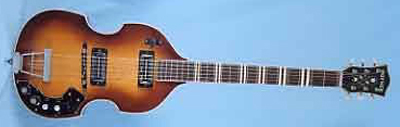
Vintage 1967 Hofner 459TZ Electric Guitar
The idea of putting “effects” on the guitar itself is as old as the volume knob, and certainly as old as the tone pot. When guitarists started putting hand vibratos on their guitars probably in the 1930s another powerful onboard effect was unleashed. As far as I know, it was probably the Germans—who else?—who added what we’d more typically call “effects” to guitars. By 1965 Framus had put the infamous “spigot” on its guitars, a spring-loaded volume control that you worked with your pinky for manual tremolo. This was a great idea but it takes a heckuva lot of coordination to get the effect!
Vintage 1967 Hofner 459TZ Electric Guitar
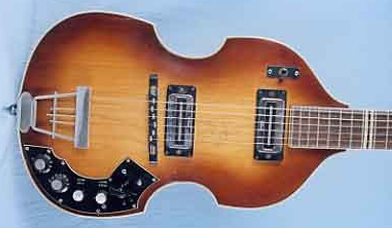
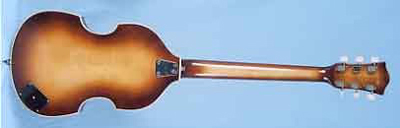
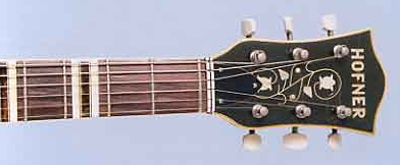
All the things we’ve talked about till now were really mechanical. Or at least I guess “passive.” As far as I know, this 1967 Hofner 459TZ may have been the first of a long line of guitars with active electronic effects built in. Of course, the first thing you notice is the violin shape, which was, thanks to Paul McCartney’s bass, the company’s main claim to fame. That alone would make it pretty cool. But then there are those groovy ‘60s Hofner celluloid fingerboard inlays. You’d like it for those. But wait, there’s more! Those nifty dual-blade humbuckers were among the best on Euro guitars at the time.
But all that pales when you consider the effects! This has basically two active circuits, perfect for your psychedelic rendition of Ina Gadda Da Vida. One, the “T,” was a treble boost. Throw the switch and (most of the time) the treble kicks in for that biting, blow your mind solo! The other, the “Z,” is a built in fuzztone distortion circuit. Want nasty? Throw that switch and (most of the time) you get that nasal idea of distortion that was big in the Summer o’ Love. “Most of the time” is basically because not everything that worked perfectly back in ’67 still does. I can swear to that.
Vintage 1967 Hofner 459TZ Electric Guitar
Reliability over time issues aside, this guitar is perhaps more quaint than really nasty. We’ve all become a bit more jaded than we were back when we weren’t going to trust anyone over 30! If I want nasty these days I prefer to stomp on my Pro Co Rat. You probably have your favorite, too. And it’s probably not on this Hofner!
Vintage 1967 Hofner 459TZ Electric Guitar
How long these were around or how many were made is a mystery, but not too many seem to show up. It wasn’t long after this guitar appeared that folks began experimenting with active onboard electronics that were more sophisticated, but still descended from this. Alembic, B.C. Rich. With overdrive boosters that gave you distortion. Then came the Freshers in the late ‘70s with built in wah and phasers. Then Electra MPCs with plug in modules. Perhaps the most ambitious were the Cort Effectors from the mid-‘80s with phase, delay, vibrato, wah, chorus, distortion…it could have had more but Cort figured players brains would melt with more choices. Do they all work? Well, not that bad. Not that good. The reality is you’d rather have an array of stomp boxes, or maybe if you’re real savvy a multi-effects rack.
Or, I don’t know, maybe just a friggin’ guitar with a couple pickups and a volume and tone control. Then just jam a pencil into your amp speaker! In any case, this Hofner began the other track of putting your effects where your fingers do the walking! At least as best as I can recall…
Don’t forget Harmony’s H66 Vibra-Jet with a built-in, battery-operated, transistor tremelo which appeared in their 1961 catalog.
Do you wanna sale this here Guitar?
I like it’s looks & shape too…
How does it sound?
How does it play?
What would you sell it for?
in Dollars $0,000.00 ???
I had one very similar, but with a vibrato. Everything worked perfect on mine except the battery holder spring was weak, I was always worried if I got too physical it’d bust loose inside there. It had nice tone. Sounds like your switch may want replacing? That’s something that CAN be done with that older gear.
I wish I’d known Tav Falco plays one, ’cause he was playing at a place I worked at, and I could have hung out for the show, &c. it would have been nice to see another one in real life. They are rather uncommon.
Is that called a Super Beatle?
This was my first guitar. I still have it. The circuitry is in a box waiting for me to work on it. Very inventive but unreliable push button switch.
I have 4 Gibson’s 2 Lesters, 1 ES and one Dreadnought, some Fenders. They all have great necks and frets. But this Hofner has the best neck and frets I have EVER played on.
It was the runt of the litter at Manny’s on 48th street. They had one of each of the 4 models. It came in blond and sunburst with trapeze or vibrato tailpiece. The beautiful blond 459VTZ was $575.- My mom wouldn’t go that high. The sunburst VTZ was $435.- (The one above is the TZ – without the vibrato. List price $395.-).
We went to the store month after month and the same four guitars were still there. The last guitars in a line of glass cases that ran down the length of the west wall of the shop. Stu, the salesman, finally got Manny to agree to $250.- just to move one out of the shop. From $435 to $250.- including sales tax, not one penny more. My mom was tough.
Hi, I am looking to buy a hard shaped guitar case for my HOFNER 459-VTZ Violin 6 string guitar as my old one has suffered over the years and has to be laid too rest as it is no longer repairable well it might take one more fix but I thought to treat my guitar. Do you know where I can purchase one from I tried Hofner but they have not yet replied to my E-mail to them about a case to fit my guitar can you help me please or will I have to make one myself, have to sharpen the tools by the looks of it I have been trying for a few months to find one so I am resigned to having to have to make my own
I believe I have one that will fit. I bought a new 459 and I purchased a case from a dealer. I purchased a mid 60’s case and it is too small for the 2019 remake.
It is the original case for the original Hofner VTZ. If you are still interested I have pics. And we can do measurements to make sure. It was never used. It came from new old stock from a New York music store.
Hello Will. I am Interested in the Hofner 459 TZ case. Is it still available?
Thanks,
Wes