


How would you feel if you got a gig playing on your local television station and your gear didn’t work? Well, in a way, that’s what happened to me and this 1965 Teisco TRG-2L guitar! Sort of.
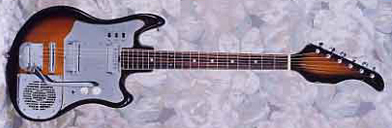
Vintage 1965 Teisco TRG-2L Electric Guitar
Like in most major TV markets, the stations where I live have a roving reporter who gets to go around and do stories on the strange and unusual. You know, pieces about people obsessed with carving pumpkins at Halloween and guys with like 8,000 Lionel trains their basements. I guess I fell into the latter category. Somehow one of these reporters found me out and called to do a story on the weirder parts of my guitar collection. Some might argue that’s the whole thing, but he meant the old Kays and Harmonies and Teiscos he remembered from his youth. I reluctantly agreed and he said “Ok, bring a couple hundred of them into your living room.” Right. You gonna carry them? Expletive deleted. But I picked about 30 or so and spread them around.
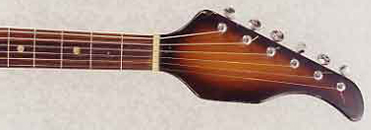
Vintage 1965 Teisco TRG-2L Electric Guitar
Anyhow, on the appointed day the reporter showed up, interviewed me, and started making fun of my guitars. As he worked the room he got to this Teisco with the built-in amp. He threw the switch and hit a chord. Vroo-crackle, crackle. It crapped out. On TV. Ho, ho, ho. More mirth. Oh, great. Doh!
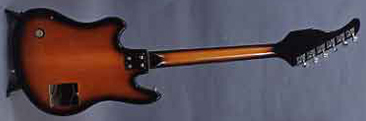
Vintage 1965 Teisco TRG-2L Electric Guitar
Then again, maybe having an amp built in to your guitar is something to laugh at. The idea isn’t new. Back in the 1930s both National and Harmony, at least, built cases with amps for their lap steels. But it was left to modern transistorized electronics, and the Japanese application of them to the earliest consumer products, to put the amp into the guitar itself. The result was this TRG-2L, one of several models introduced in 1965 that had a small amp and 3″ speaker built in, operated by two 9-volt batteries. These came in a kind of Stratish shape and a sort of Tele-ish shape. One or two pickups. These were the first of their kind.
Ok, the TV performance aside, these actually do work and are kind of fun to play. You can walk around the house and strum without the tether of a cord. Wanna go to the beach? No need for a plug to entertain that campfire circle. Louie Louie, Oh yeah, we gotta go now. (Or were there other words?) And, like most Japanese guitars from this period, they’re really quite well made – and play well – once you set them up properly. The body is solid mahogany (maple neck), and, in case you’re not at a pig roast, there’s even a headphone jack if you want to use this as a practice guitar.
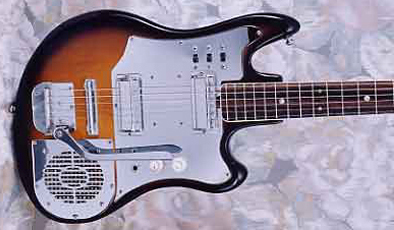
Vintage 1965 Teisco TRG-2L Electric Guitar
Of course, practice and Pignose amps came much later. But guitars like this Teisco were revolutionary in their time and are still fun to play. You can even run them through a regular amp if you want to make a different kind of impression.
Although you might not want to do it on TV. If these early Japanese guitars have a flaw, it’s in the use of extremely thin wire and economical use of solder. Easy to get that crackle, crackle when you least want it. I’m told the video of me trying to salvage some respect for my goofy guitars still circulates occasionally on late-night Philly airwaves (and cable whatever they are). At least it wasn’t me who lost it on TV! Blame it on time and the Teisco. And that darned cynical reporter.
Greetings,
I’m trying to repair one of these exact models for a friend but am having a really hard time finding a schematic for the amp board. I was hoping you may have some documentation with yours that you may be willing to share. All I can seem to find is a schematic for a TRG-1 and tht’s not the same. It’s for a good friend who has a sentimental attachment to this guitar and I’d relaly like to help him out.
If you don’t have a schematic, I’d really like to know what part numbers are on the 4 transistors on the amp board. If you decide to get yours fixed and have it opened up, it would be a huge help to know these 4 part numbers.
So far I have found problems with the switches with my friend’s guitar which you may well have with yours. It took a lot of contact cleaner and flipping the switches back and forth about 50 times to get them cleaned up and operating reliably. Unfortunately, there is still a problem with the amp board itself.
Thanks !!!!!!!!!!
Fred
hey fred,
i have a similar guitar but the silvertone model which i got quite cheap from ebay. unfortunately the amp in mine didn’t work either. i took it to an amp repair guy and he also said he wouldn’t touch it without the schmematic. because the pickup also sounded quite crappy through an amp i decided to redo the whole thing with a new pickup. had to do a new pickguard cause mine was made of metal and didn’t feel like cutting a new hole in it for the new pickup. got a cheap little 18w amp module that runs on 6-20v from an electronic store, hooked it up to a 9v block, hooked it up to the volume pot, put in a new switch for the power and then hooked it up to the original speaker. i’m guessing the original amp in it didn’t have much power but the new one is loud! so loud i get a nice distortion out of that little speaker when the volume’s full up! this little guy is gonna be fun at the beach, the park or even backstage before a gig! just finished it last night and i’m curious to see how long the battery will last.
cheers,
richard mcphail
I’ve got that same guitar and like you, the amp died many years ago.
I replaced it with the amp from a Radio Shack battery powered speaker, running on 6 9 volt batteries. It will easily go into infinite distorted feedback it I turn the volume up.
http://smg.photobucket.com/albums/v390/skb/misc%20stuff/Guitars/?action=view¤t=silver_tone2-1.jpg
thank you I no now is a kay
Derek Trucks was playing this guitar on a video concert this past week.