


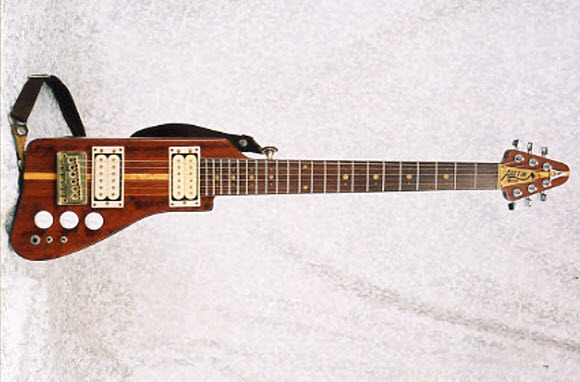
As a rule, I’ve never been too enamored of “pop” music, if you define pop as largely vocal-oriented music with catchy melodies and easy-to-remember lyrics, almost always love-themed. So, ordinarily, a pop band like The Police would be off my radar. Still, Andy Summers was able to weave some pretty interesting guitar textures—without traditional flash solos—behind Sting’s singing, so I paid attention. Besides, it was Andy Summers who almost single-handedly created a market for minimalist guitars like this c. 1985 Austin Hatchet.
Vintage 1985 Austin Hatchet Electric Guitar
Summers famously played a headless Steinberger guitar, which is probably the best known minimalist guitar among guitar fanatics. But it certainly wasn’t the first. I suppose the earliest in the category were the first successful electric guitars, the first Hawaiian lap steels. The legendary Ro-Pat-In Electro “frying pan” had a body, neck, and head, but it sure was minimalist! Most electric laps had these elements, but by the 1940s these were pretty perfunctory. How many lap steels are basically a slab of wood with some pickups, a “fingerboard,” and some tuners, reducing a guitar to its bare minimum?
Vintage 1985 Austin Hatchet Electric Guitar
I’m not sure who gets credit for building the first minimalist “Spanish” guitar. It pretty much had to be an electric guitar, since acoustics depend on having an acoustic chamber to produce their sound. In 1967 Dave Helland, then a music teacher in Green Bay, Wisconsin, got the idea that an electric guitar needed to be nothing more than a 2×4 with a neck. He had a couple dozen of the legendary La Baye guitars built.
Around the same time Dave Bunker, a guitar player and luthier came up with his Astral guitar designs. These looked like a cross between a Star Trek starship and a guitar. However, many of the parts were screwed onto a minimalist core, so you could customize the way it looked when you performed.
Neither the La Baye nor the Astral guitars were particularly successful, so you’ll be lucky to ever play one. The ultimate in minimalist guitars were probably the so-called “fishbone” jobs built by Alan Gittler in New York during the mid-1970s. These reduced the guitar to a tubular spine and tubular “frets.” Indeed, Andy Summers played one of these for one of his Synchronicity videos. Only 60 of these were ever made before Gittler moved to Israel, where he became Avraham Bar Rashi and contracted out another 240 or so of a slightly more substantial version, still remarkably minimalist.
Vintage 1985 Austin Hatchet Electric Guitar
Around the same time that Gittler was building his fishbones, Ned Steinberger was coming up with his small-bodied, headless design, which was produced by Stuart Spector. These went on to become the most famous of minimalists, thanks, in large part to The Police. Steinbergers were, however, expensive. To help fill the void, Cort licensed the design and began producing cheaper versions, bearing the Cort name as well as others, including models for Hohner and Washburn. I have one called Blake that used to be my “shore guitar.” In 1981 Kramer threw its hat in the ring with its aluminum-necked, headless Duke guitar.
None of the guitars mentioned so far were “travel guitars,” strictly speaking, though it was nice that you could pop your little minimalist guitar into the overhead compartment or on top of all your vacation luggage. There were travel guitars in the game at the time, including the little yellow Hondo Chiquita Banana. They were only minimalist in the same sense as the early lap steels in that they were small.
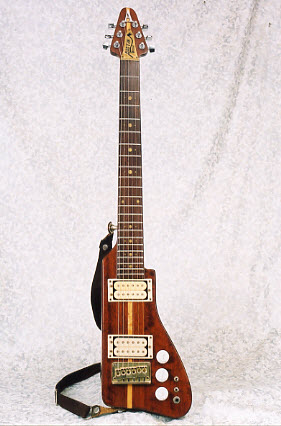
In any case, this was the environment in 1984 when Jack Westheimer of Cort got the idea to come up with his own cross between a minimalist and a travel guitar and designed this guitar. Actually, Westheimer’s inspiration was less the Steinberger or Duke or Chiquita and more the Colt 45 handgun. Yung Park tweaked Jack’s design and in 1985 the Cort 45 debuted. Jack used to laugh that he was the only one who ever connected either the name or the shape of the guitar to a pistol! Obviously the big distributor Targ & Dinner didn’t because they called their version the Austin Hatchet, seen here.
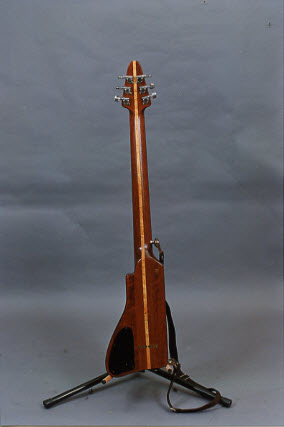
Vintage 1985 Austin Hatchet Electric Guitar
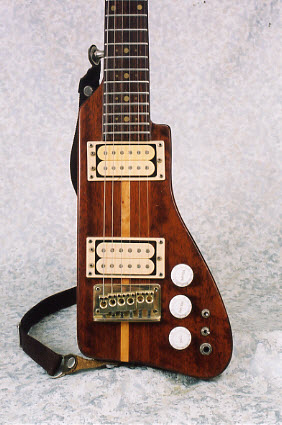
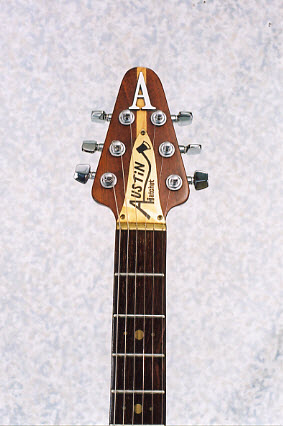
If you like playing minimalist guitars, this actually isn’t too bad. The neck-through construction gives it a solid feel. It’s powered by a pair of Korean Powersound humbuckers that are actually pretty darned hot. One of the mini-toggles is a threeway while the other reverses phasing. The headstock and tuners do make it a little top-heavy since there’s not much body to act as a counterweight.
I’ve never seen a Cort 45 and only a couple Austin Hatchets. That’s no evidence, but I don’t think these were too popular! They seem to have been gone by 1986. While other minimalist guitars like the Steinberger soldiered on (even they started getting bigger bodies), the craze for minimalist guitars had pretty much run its course. Which, come to think of it, pretty much also describes The Police, who broke up that same year. I can’t recall listening to any other “pop” bands since then either.
I guess you actually mean “first minimalist production guitar”? Apparently (according to Wikipedia) Les Paus experimented with his minimalist steel body in the ’20s, did the wooden “log” in the ’30s, approached Gibson in the ’40s (and was rejected), and his experiments were finally marketed by Gibson (with him as consultant) in ’52 as the “Les Paul” (no longer minimalist, for marketability).
Dear Michael Wright,
I thought I would share information in relation to this article with you. First, if you follow the news of the NAMM show on Premier guitar web site or their emails, then you know that the Gittler is back. I saw singer Nico in 1980. Her accompiest played a gittler. I imagine they have a web site. Check Premier for news of the resurrected Gittler.
I had a Cort 45.I purchased it in 1984. It looked like the Austin Hatchet almost exactly. I no longer have it. I traded to a guitar dealer in Canton, Ohio in 1990. The differences on my Colt were this: There was a 2 inch groove in the headstock where the letter A is on the Austin Hatchett. There was a built in guitar strap on it. A bracket in the back held the strap in the body. The other end of the strap had a hook similar to those on a gig bag. It attached to a metal loop drilled into the body where a regular strap button would normally go.
My 45 was modified. I added a Bill Lawrence pickup in the bridge position. I also put gold flat rings on the guitar and a black cover on the Cort neck pickup. If you see one like that, It was my old one.
If you go to YouTube an search “Austin Hatchet” you’ll see me playing a couple of these. A really good guitar. Sounds great and it’s perfect for slide.
I had a copy of this as my first guitar in the 80’s made by kay! The strap was attatched thru the back of the body and the option of two attachments on either the base of the neck or at the back of the headstock. It also had a shaped leather case. It was replaced in 1988 and i have no idea what happened to it!!!
I think this is a real great blog article.Much thanks again. Cool.
I actually have an Austin Hatchet. I bought it off of E-bay for under $200 about four years ago. I installed a strap lock system on it but kept the rest original. I use it for a travel guitar and like it very much. To offset the heavy head, I use a carabineer and attach it to the bottom of the guitar strap with the other end attached to my belt or belt loop on my pants. This actually fixes the bad balance of the guitar just fine. Without this little modification, the balance is so bad that playing while standing is quite difficult. But the neck and frets are nice, the pickups provide a nice robust and full tone. It’s not my primary guitar, but I don’t think I’ll ever sell it. It is such a great little travel guitar and a lot cheaper than a Steinberger!
Cort 45 Gun shaped guitar!
Great article
I have an Austin Hatchet without the built -in strap is there a way I can modify it with one
Hey mat swine!!
I think I may have your guitar from back on the day. Purchased it on eBay and this has exactly what you described!
Sounds just as good as my aluminum neck Kramer! The Cort 45 can do that sound without much effort. Crazy power from such a small axe. Brilliant.
hatchet!!!!!!