


I have been playing guitar for 40 years. I have owned everything, from ES175 to a 58 Les Paul Std, 59 Strat, Travis Bean, Alembic, Cort, Samick, Guilds, G + Ls, you name it, I owned one. And you know what? If I see one more damn Les Paul, Strat or Tele I think I will vomit! Good lord, are they the most boring thing in the world or what? I love guitars that are different. I do NOT want to see another guy walking down the street playing the same guitar as me. There is a world of cool guitars out there and yet some guys have no imagination, they just play the same blankity blank guitars that everyone has had for the last 50 years!
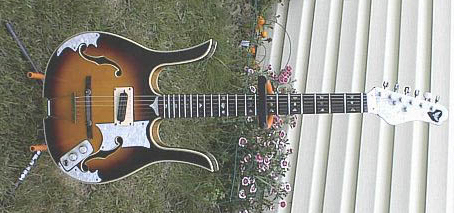
Custom Longhorn Guitar by Bill Wagoner (Plymouth, IN)
Here is one of my solutions to the problem. I bought a 1968 Coral Longhorn Body off of EBAY for 65 bucks. It had never been used, no neck, not even a neck pocket, no routing for pickups, no wiring, no pickguard, nothing but a body. Enclose is a pic of the body as I got it and the guitar I made out of it. I did all the wiring, inlays, designed and made the pickguards by hand, assembly, set up, everything.
My inspiration for this project was the old BIGSBY guitars made by Paul Bigsby back in the late 40’s and early 50’s and also the gaudy Cool Italian guitars of the 1960’s. Also I was thinking of the original handmade Mosrite stuff where Semie Mosley would include a fancy pickguard, arm rest and so forth.
My first step was to decide on pickguard material. I went with the white pearloid, or what I call Mother of Toilet Seat, in other words, fake pearl. My pickguard material came from ALL PARTS. I sell their stuff in my store and it is great quality. I knew that I wanted to cover the entire headstock with it but that presented a problem. The neck is basicaly a generic strat type neck but since you cannot bend the thick pearloid I had to make it two pieces. I decided to make the second piece double as my truss rod cover. The neck came from a low priced strat style guitar called a Palmer. Great neck for almost no cost and it plays like a dream.
Next was attaching the neck and body. Since this body had never had a neck, there was no neck pocket. After observing what I call the First rule of guitar repair, I routed out an area to attach the neck about an inch of so deep and also removed part of the material under the fingerboard to get the proper slant to the neck in relation to the body. Due to the fact that I was going to use a rosewood archtop bridge I did not need to worry about where I placed the neck since I could position the bridge anywhere I wanted after the guitar was together.
What is “The First rule of guitar repair?” For every minute you DO something to your guitar, you THINK ABOUT IT for 20 minutes FIRST. If you take your time and approach guitar repairs this way you will make a lot less mistakes in the long run! After attaching the neck, I started on my Inlays. All it had when I started was the boring and traditional plastic dots. I drilled those out of the neck and replace them with real abalone dots. Next I used diamond shaped abalone pieces that I bought from RESCUE PEARL Company and cut them into triangles. Then I routed the fingerboard and added them to make the pattern you see now. You can do a search and find Rescue Pearl on the net, nice folks and very helpful and reasonable prices too. I then started to design the pickguard. I wanted it to follow the lines of the F-hole rather than hide the F-hole as they do on so many hollow body guitars. I used old file folders and cut the patterns from them with scissors after drawing them free hand and then copied them in pearloid. The arm rests and the control plate were done the same way. I used an old Seymor Rail pickup I had laying around and kept the electronics simple since there is a limited amount of space on the body anyway. I also made sure to position all the electronics where they can be worked on easily from the F-holes in the future.
Finally I strung her up and added the ALLPARTS Rosewood bridge. Incredibly, the intonation on this guitar is perfect, no need for tune-o-matic bridge saddles at all. It has a wonderful warm woody tone that is different than any of my other guitars and I just love it. Add to that the fun of making it myself and I have a guitar that will never leave my collection.
Post by: Bill Wagoner (Plymouth, IN)
Sweet looking guitar, Bill!
Yeah, it’s the greatest feeling knowing you’ve accomplished something that is as pleasant to the eye as it is to the ear.
I’ve done the same sort of thing myself, and it does take time to think about what you want to do. Everything has to be thought out, and it’s always good to write down what you plan on doing.
Nothing is worse than closing up your guitar, thinking you’re finished,setting it down on your knee ready to play and saying “Shoot, I forgot this or that”.
Great project! Just bought one of these never finished lost Longhorns off Ebay, now they are a lot more money(or I was dumb enough to pay 3 times what you paid in 2005). This is an old post but Point of my writing is to inform the public that although they are cool looking in a bizarre way they are made of plywood, with nice veneers of maple and spruce, but I was disappointed as a lot of info of projects on the web seem to infer that they were “wonderful wood” not like the rest of Dano/Coral that were mostly masonite. I am not sure plywood is better than masonite. I am taking into consideration that many famous Gibby and Epi guitars of semihollow -with- pickup design were made of plywood also. Guess if I had paid $65 bucks would not be so pissed. Oh, well I plan on making a 30″ bass VI out of it,
Cheers
Iam the new owner of this amazing longhorn guitar! I also own another of Bills guitars. He was an amazing guitarist!
I’am the current owner of this guitar, let me tell you, it is amazing! It’s got a Seymour Duncan Hot Rails Pickup in it and it can scream! It sounds great with or without effects and the look of the guitar is not the only thing that is amazing about this Longhorn! The tone is perfect and flawless! It will never leave my collection! Bill was a great guy and mentor as well as a friend to anyone that walked into his music store. He was a great guy and is dearly missed.
I have built 6 of these in different styles 6,8 Mandolin 8 string guitar 12 string 5 string banjo 6 string twin pickup I’m fascinated by them most have floating pickups love yours
I’m still building these I don’t like to sell them so I guess they tales and strats will have to go