


What were they smoking when they dreamed up Messenger guitars? Such an exquisite combination of the revolutionary and banal. Well, it was San Francisco in the Summer of Love, 1967. Imagine a Cheech and Chong routine. “Like, wow, man. What if we made the neck out of a magnesium-aluminum alloy so it wouldn’t warp and then continued the block of metal on through the guitar to cut down on feedback?” “Yeah, man, we could put cool Ricky catseye soundholes on it.” “Groovy! And we could wire it so you could play out of two amplifiers at once. Like stereo, man.” Have another hit. “Then we could make it a ‘peoples’ guitar and put crummy DeArmond single-coil pickups on it like on really cheap Harmony guitars.” “Like, wow, man. Right on.”
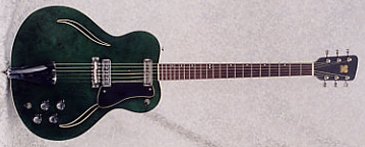
1967 Musicraft Messenger Electric Guitar
I don’t remember exactly when I’d heard about Messenger guitars. But many years later, having a nice collection of guitars with aluminum necks seemed like just what I needed! I needed a Messenger.
Sometimes these things are fore-ordained. No sooner had I decided to snare a Messenger than I scanned the ads in Vintage Guitar Magazine and turned up a minty Messenger for $750. I couldn’t believe my good fortune and got on the horn immediately. He was a nice chap, but he’d already had an offer of $1800. I didn’t want a Messenger that badly. (Little did I know what a good investment that would have been!) Crestfallen, I was about to hang up when he said, “But I’ve got this green pro refin I’d sell you for $350.” New paint or an extra $1500? You do the math!
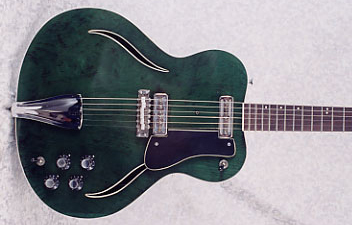
1967 Musicraft Messenger Electric Guitar
Messengers were revolutionary. While early Electro Hawaiian laps were aluminum “frying pans” and the Italian designer Wandré Pioli had made far-out aluminum necks in the late 1950s, Messengers were the first really modern aluminum-necked guitars. Created by Musicraft, Inc., Bert T. Casey, president, and Arnold B. Curtis, head of marketing, they play like a dream – just ask Mark Farner of Grand Funk Railroad, who used them (modified). The aluminum “chassis” eliminated the need for a heel, improving access, and it was actually tuned to A-440, supposedly to improve resonance. The M logo looked, well, like a big ’60s hairdo. The stereo concept was simple and great (two mono jacks for each pickup, but throw the switch and both pickups go through just one).
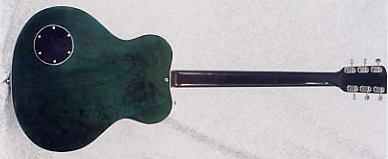
1967 Musicraft Messenger Electric Guitar
But, like so many cool guitars, the weak point in the Messenger’s armor was under the hood. Now, I love chintzy ’60s single-coils, even the microphonic units, but if you’re going to create a hi-tech axe, why would you put those DeArmonds on? Why not some Filter Trons? Or Gibson or Guild humbuckers, like John Veleno a few years later? Despite its alloy chassis, Messengers were hardly fit for the emerging heavy metal craze! In the end, it didn’t matter.
By 1968 Messengers had abandoned San Fran for the rarer clime of Astoria, Oregon, for “expansion” purposes. Shortly thereafter the Messenger had departed, if not shot with a smoking gun, certainly dead. And certainly rare. If you could find one, you’d gladly pay the $1800 I once passed on.
Well Michael, you nailed it…the DeArmond’s were the Achilles Heel of the Messenger. A fatal flaw that might have been corrected but for the times and circumstances. My Dad worked as Production Manager for Musicraft in Astoria. Bert Casey was his boss. I was 14 and played well enough to know the DeArmond’s were a creative brick wall. I lobbied Dad night-and-day to get Humbuckers on the Messenger, but to no avail. It would have been expensive, and by that point Musicraft’s bow was in the mud.
Still, in it’s time the Messenger had enough balls to make the front cover of GFR’s Inside Looking Out album and rumor has it Ronnie Wood played a Messenger on Maggie May. Also, if memory serves, Nitty Gritty Dirt Band was under contract to promote the Messenger in the late 60s, but I don’t know if it’s fair to say they did.
Fast neck though, eh? And 21 frets clear of the body!
Messenger also made some impressive-looking amps for the time. There is virtually no info online about these. A photo of the Messenger sponsored Portland, OR band The Sirs can be found here: http://pnwbands.com/sirs.html
DeArmond’s are rocking PUPs I dunno maybe you guys are smoking Chong’s stash?
Hi Rick:
Who is your Dad? I remember someone named Chris Rose who was also intimately involved in the production of the Messenger Guitars in Astoria.
-Eric
Rick, are you Rick Murie? If so, I remember your dad taking that job in Astoria when we were in grade school in the mid 60’s. The name Messenger always stuck in my mind. I was just doing a web browse and voila. Found the guitar info and maybe an old friend.
Hope its is you.
Geoff? Yeah it’s Rick Murie. It only took 15 months for your message to flow through. I would love to see you and learn what’s gone on with you these past 45-years, or so. Last I heard you were a professional photographer living and working in NYC. That was surely more than 30-years ago. Please get in touch. rlmurie@msn.com
I agree, De’Armonds sound killer. Listen to
Mark Farner play his on a a live version of
Inside looking out on YouTube, great tone.
When he hits the fuzz, yeah baby!
Very interesting comments. Yes, the pickups were a problem and would have been changed but there was not enough startup money to make the guitar better before production started – needed cash flow to stay alive. I was the guy who assembled all but 4 of the 324 units built. It’s a long story about the rise and fall of a great instrument. There are still a few of us living in the Astoria area.
This is Chris Rose, I’m the guy who assembled all the 324 units that went to market. There are a few proto types that I did not do that seem to show up on the internet once in a while.
Yes, the De’Armonds were a problem and would have been changed but the company ran out of development money and the economy dropped, a bad combination that we couldn’t survive. We were in full production for less than a year.
Jefferson Airplane was another group using our instruments – primarily for recording.
Would love to find a nice Messenger 6 string.
Previously owned a fretlesz bass Messenger in natural. Think sombody converted a fretted one originally.
Feel free to call. Love to learn history, etc.
Thanks.
Chris Yent
941-330-7041
I met Alan Woody back in the mid 80s in Nashville via George Gruhn. Alan owned a Messenger Bass, and I own a Rojo Red stereo guitar. We compared the instruments and agreed they are unique. I still own mine and use it for recording.
I bought a Messenger back in 1974 for $200 when I lived in Connecticut. Had to have it since GFRR was (and still is) one of my favorite bands. The one I bought have a traditional red sunburst finish but no fuzz switch. Mark is right about the feedback. Damn that guitar would squeal whenever I turned up the amp. It did have a beautiful tone when played at lower volumes (think I’m your Captain or Aimless Lady). The neck was great since it went through the body but the cheap DeArmond single coil pickups sucked big time. Mine also had a Bigsby tailpiece that I didn’t really care for. It was a bitch to restring. I almost never played it on stage because of the feedback problem. I did end up selling it a few years back after owning it for over thirty years. Sold it on eBay for 6k to a dude on the west coast who wanted to copy the guitar and maybe make more, not sure.I did keep the bridge cover though. It’s sitting on my desk as I type. Sigh
Does anyone know how to contact Chris Rose? I just purchased a Messenger and there is just so little info on the changes in the guitar’s features, I was hoping he remembered some of it. Changes included control knob layout, bridge saddles used, pickguard shape, etc. Mine is Midnight Green but in the original brochures from July 1, 1967, that color isn’t even mentioned as a choice. The original Messenger with the Tone Messer fuzz circuit retailed for $362. Thanks for any help.
you know, all the talk about the crappy pups? the proof is in the pudding. i for one am glad that was the guitar and the pups. killer sound.