


Yeah, man, that’s why we get into guitars, isn’t it? All of which is evident in this cool Summer o’ Love 1967 Fender Coronado XII Wildwood!
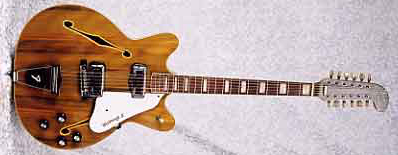
1967 Fender Coronado XII Wildwood 12-String Electric Guitar
Whether some cat took LSD, or anything lighter, while playing this guitar is also unknown. But there’s NO doubt drugs were involved. That’s because this is a Wildwood. And we’re not talking Jersey Shore here.
Well, ok, we really don’t know for sure about the sex and rock. This is a Fender electric guitar, after all, and I don’t think someone bought it to play jazz standards. Or Kumbaya. So that’s a yes on rock ‘n roll. And, anyone who’s ever played rock, by definition, had to think playing it would lead to at least the chance of a score – I know it’s circular logic, so let’s move on to the drugs.
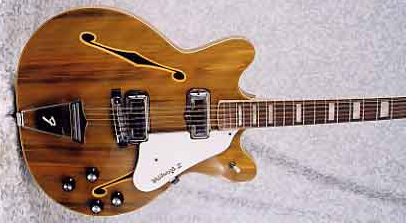
1967 Fender Coronado XII Wildwood 12-String Electric Guitar
The Wildwood concept was invented by a Danish inventor, who hit on the idea of injecting dyes into growing beech trees. As the trees matured, their wood grain colored in green, gold and purple, gold and brown, dark blue, purple and blue, or blue-green. Someone at Fender, thinking this must be what the kids were looking for, bought the idea of making guitars out of Wildwood. Groovy.
The task of designing Wildwood guitars fell to Roger Rossmeisl. Roger is hardly a household name among general guitar fans, but he’s known to cognoscenti. Rossmeisl was born in Graslitz, Germany, in 1927. He learned guitarmaking from his father, Wenzel, who built Roger archtop guitars during the 1930s and introduced the first electric guitars to Germany in 1947.
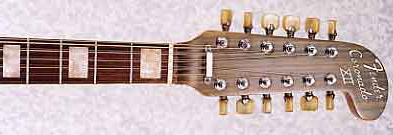
1967 Fender Coronado XII Wildwood 12-String Electric Guitar
In 1952 Roger came to the US and landed a job with Gibson. The gig did not work out. Persistant, Rossmeisl went West and hooked up with F.C. Hall and Rickebacker. Accounts are fuzzy about the next facts, but by 1956 Rossmeisl was responsible for designing the Combo 600 and 800 series solidbodies, the legendary 4000 bass, and the Capri lines. He introduced both the top-relief German carve to American guitars (cf Mosrite; Semie Moseley briefly worked for Rossmeisl) and the more specific cresting wave design.
That alone would be enough to secure his fame, but Rossmeisl next approached Leo Fender about designing a line of bolt-neck acoustics in 1962 and was hired. In 1963 Fender’s broomstick acoustics debuted with a support dowel running from heel to tail and, significantly, exotic woods. Not new but cool. And not popular.
Roger is supposed to have known the Danish drug dealer and brought him to Fender. The Wildwood acoustic dreadnoughts and thinline electrics debuted in 1966. Which brings us back to this Coronado XII. The colored graining is in nifty green. The construction is solid, though hollowbodies without a log are not my favorite. And, even though my father hailed from Toledo and I’ve lived there several times, the Glass City’s DeArmond pickups have never been on my must-have list.
Fender Wildwoods officially lasted until 1971, but they were hardly a success, and are now a part of guitar legend. Japan’s Teisco company produced some knock-off Wildwood-style guitars, but they were not any more popular. Roger Rossmeisl returned to Germany and eventual obscurity. Leaving us only, I guess, sex, drugs, and rock ‘n roll – and the Fender Coronado XII Wildwood.
Hello there, where can I buy a 1967 Fender Coronado XII Wildwood 12-String Electric Guitar? I have searched everywhere and simply can’t find anyone who has this. If willing to sell please let me know with a price.
Thanks,
Alex
https://www.myrareguitars.com/1967-fender-coronado-xii-wildwood-12-string-electric-guitar
to Alex H,
I have a coronado XII 12 string electric, in almost perfect condition.
I have owned it since 1971.
I am willing to sell at the right price.
Sylvia K.