


Travel with us now Back to the – no, not the Future, but – the 1970s! Back when things were all natural and stuff! Back to nature. Long hair. Deer-hide jackets with fringe. Back when the taste for things au naturale began to show up in guitars. Back when clearcoat finishes began to reveal alternating laminates of light and dark wood, often maple and mahogany or walnut. Back to a time when Martin built this 1979 Martin EM-18. Say what? Martin??
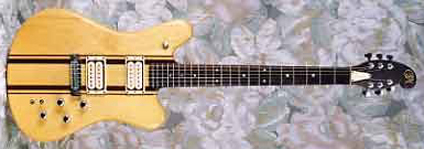
Vintage 1979 Martin EM-18 Electric Guitar
Yes, Martha, that’s Martin. That’s because the late ’70s was one of Martin’s periodic failed attempts to break into the electric guitar market. That Martin never managed to challenge Fender or Gibson, or anyone else, for that matter, doesn’t mean they failed to make a pretty good guitar. Just that venturing outside your core competency can be pretty risky! So when I found this in a pawn shop in Philly, just down the pike from Nazareth, I had to pick it up!
Martin’s first attempts at making electrics occurred in the 1950s when it tried slapping DeArmond pickups on dreadnoughts. Ever hear of those? Then in 1961-62 Martin tried to market some thinline F-series electrics. These were pretty cool guitars with a unique design, but they never really caught on and were gone by mid-1965. Fast forward to the ’70s.
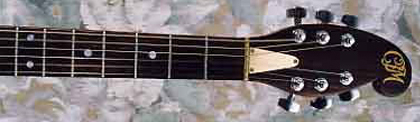
Vintage 1979 Martin EM-18 Electric Guitar
The 1970s were a strange time, to say the least! It had anti-war protests, wild inflation, fondue, gas shortages, odd new Japanese cars, presidential resignations, new STDs, and, man, disco. Disco! Guitarists were panicked by disco. Most of it was played on keyboard synthesizers and axe-slingers were afraid interest in guitars would disappear! Of course, they hadn’t reckoned on a young Eddie Van Halen! In contrast with the glitzy glam of disco spandex was the “back-to-nature” look.
The taste for natural-looking guitars coincided with the end of the Copy Era in 1978. Elger Guitars, the American beachhead of Hoshino, makers of Ibanez guitars, established itself by making high-quality copies of American guitars, as well as creating some interesting variations and original models (think Iceman). When Norlin/Gibson sued them, they introduced the Musicians and Studios, inspired by the neck-through, active creations of Alembic (and the Grateful Dead, kings of natural enjoyment). While somewhat more exotic in shape, Bernie Rico’s B.C. Rich guitars were also within this mode, as were the lesser known S.D.Curlees.
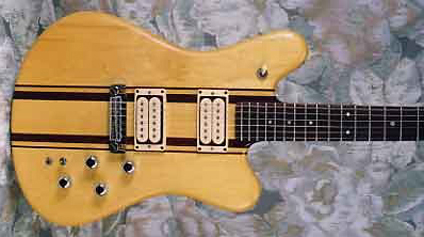
Vintage 1979 Martin EM-18 Electric Guitar
So anyhow it was into this mix of anti-disco naturalness that Martin tried again with its E Series. The Es were the creation of Dick Boak, who came to Martin as a draftsman in 1976 and by ’77 was given the project of coming up with some new electric guitars. Like many designs of the late ’70s, these have a kind of “organic” quality that’s unique in guitar chronology. The prototypes were produced in ’78 and the guitars entered production in 1979. Two guitars and one bass were made, all with glued-in necks and the retro “Stauffer-style” headstocks, reflecting Martin’s original 19th Century guitars. The guitars were the E-18 and EM-18. The E-18 came with a pair of DiMarzios and a phase switch. The EM-18 sported Mighty Mite pickups with series/parallel switches. The EB-18 was a bass version with one DiMarzio, though later versions had Schallers.
Following the au naturale aesthetics, this EM-18 has a 9-piece maple and rosewood laminated body, with a set-in mahogany neck. This is really a decent guitar, with screaming pickups. Mighty Mites were hot! Rarest of the ’70s Martins was the E-18 at 341 made. 874 EBs were produced. Most plentiful was the EM-18 with 1375 being produced until 1982. Serial numbers began at 1000 and this is #1034, so it was the 35th made.
Alas, for better or worse, the fad for “natural” guitars was pretty much over by the early ’80s, when these guitars bit the dust. Martin imported some Japanese-made Stingers following the E-affair, but never again really returned to the idea of competing in the solidbody arena. Dick Boak would later become one of Martin’s key marketing people. Finally, in fairness I have to say that despite the great fears about disco, there actually were a fair number of them that had some bitchin’ guitar parts! So it wasn’t quite as dire as we thought at the time. Seems to be a pattern there.
A FRIEND OF Mine has 1 that has a 2 octave neck he said it was a reject when he got it it had no electronics it’s still like brand new
Please send some pics. Would love to see them! Just go to the Contact page and send them to me from there.
I’ve played an EM-18 for 20 years. It is one of the most solidly built guitars I’ve seen. It produces many different tones courtesy of the phase reversal and coil-tap switches, all of them very usable. The only trouble I’ve experienced with it is the lack of replacement parts available today. Example – I’ve been searching for a NOS Leo Quan wraparound bridge/tailpiece for the past 3 years with no luck whatsoever.
Mine looks a bit different than the one in the pic…the pickups are black as opposed to cream-colored. In the past 20 years, I’ve seen only one other example of this model in a music store. That one had factory installed strap-lock type buttons and a high-gloss finish.
I have a EM-18 with the black pickups serial #3214 with original paper work of purchase 9/10/82 and hard case all in perfect condition. Due to illness I am considering selling it for the right price.
I have a EM-18 with the black pickups with original paper work of purchase 9/10/82. Due to sickness I am considering selling it for the right price.
Martin also ran a series of electrics (stratocaster copies) form basically 1985 to 1996. Sales started dropping off in 1992 leading to their ultimate demise. This series of guitars went by model designations “SX”, “SSX”, “STX” and I believe there was a “SL-1” These model designations have caused some confusion over the years because “Rondo” guitars sells a SX Hawk or Hawk SX.BUT the Martins were designated “Stingers” some had headstocks marked (for instance) “CF Martin STINGER SSX” and some were merely marked “STINGER SSX” leaving off the famous “Martin” name-BUT if the headstock says “STINGER”-you have a Martin Electric Strat Copy that is now very collectible. Don’t believe me? Try and find one. There’s one on ebay right now for $199.95 but all the electronics are missing, the bridge and pickguard are missing, the tuners are missing (they came with Grovers) even the ferrules that go in the tuner holes in the headstock are missing nd the guitar has some CRACKS at the neck/body joint. I’m sure that Fender, Squire or the myriad of aftermarket strat parts would fit right on this guitar but then you would lose it’s collectible value. I seriously doubt that you would find the actual Martin parts for replacement. These were surprisingly well-built guitars, very playable good fit and finish and great sound/tone. They were inexpensive guitars but they weren’t “cheap” I bought a white on white (on white) one brand new back in the fall of 1989 for $149.99.I made the mistake of giving this guitar to my oldest son back in the early 90’s and (without telling me) he pawned it-talk about mad. 3 or 4 years ago I found one exactly like the one that I had on the internet and the guy wanted $3500.00 for it !!! I seriously doubt that he got that kind of money for it and I highly doubt that they are bringing in those kind of prices but as I’ve said-they are collectible. They were built under Martin’s specs by Samick (who built everybody’s imports) and then shipped to Martin in the U.S. for set-up and final inspection. I have to repeat that these are very nice guitars-very nice. I got lucky 3 or 4 years ago and came across a black one with a blck pickguard and black pickup covers with a maple net and maple fretboard (Very Dave Gilmour-looking) for $80-the guy didn’t know what he had, but he knew it was “electric” because he could see a nine-volt battery through the slots in the rear tremelo spring cover (the battery was being used as a tremelo block)-the guitar had apparently belonged to his brother who was “gone”) Only problem was is that it’sa “Lefty” and I’m not. I took it home , removed the battery, restrung it for right hand plugged it in and it played beautifully . Thanks
Wow!! I played one of these brand new in the early 80’s at the music store I hung out at. No one wanted an untested Martin electric, but it was a superb playing instrument. I’ve thought about that axe over the years and wish I’d bought it. It was cheap, too. Maybe $175…$200. The store owner wanted to get rid of it and I’m sure I could have talked him down, but didn’t. I bought a Gibson S-1 instead. I played it a couple of weeks and decided to take it back and trade it for that Martin. Of course, it had been sold by then and he refused to order another one. So, NOW I decide to search the internet, find the best one and the right price and make it happen. NOT!!! Only 450 were made. Extremely RARE. If anyone know where one is I’d love to know about it.
Thanks
Davo
I have bought my Martin EM 18 in early 80-ies. Played it for al those years, but since 5 years i switched to Fender. So now my martin is for sale.
Live in Belgium, so you have to consider delivery cost.
Guitar is in perfect condition, asking price 750 euro.
I bought a e-18 a couple years ago in Payson Arizona for $500 in primo shape. It has all the original paperwork and warranty. Love this guitar, Charlie
hello, i have a guitar almost the twin of this Em-18, except it says SigmaGuitars ESt.1970 and the pickups are black and it does not have the two togle swcithes by the vol and tones, same wood finish and color, s/n 0000140, very well made guitar, it sounds good,can you tell me anything else about it, like the name of it or series, thank you.
Is someone intrested to have a Martin EM-18 with original case.
Looking to buy em-18, anyone have one?
That’s really ugly…
Hi looking for a bridge for one any one have any leads
Thanks for your time
Ben
I own a 1979 em-18 martin with bad ass bridge and mighty mite humbuckers and the original case. A fine playing and sounding guitar. Not for sale.
I have an original Martin one piece bad ass bridge if that is what you’relooking For. Brand new, and still in the box. Also have the original sealed Martin tuning pegs, also new in the box.
Is this in fact laminated? What does ot weigh?
I bought mine brand new in May 1982. Still have it and love it!
I purchased one new with case in February 1979. It was a pretty sweet instrument. Other than the weight (the thing weighed a ton) I can’t recall anything about it I didn’t like. It was my second guitar purchase and a gift to myself for my 14th birthday, along with a Fender Princeton Reverb amp. It served as my main guitar until it was stolen in ’99. I believe it cost $329 back in ’79.
Hello, can’t believe i just saw this guitar at a local shop today, but with ‘stock EMGs'(passive) and going for $700.00. I’m at odds with the EMG brand anyways, but soo tempted to pick up this gorgeous beast. Could the EMGs be original? Any comments would be appreciated!
No the EM-18 came stock with might mites,and you might want to check the EMG,S they should be active.and not passive
Hope this helps you.either way you should purchase it for $700,unless it’s a total mess.
There were only 1375 made
I own a very clean E18, really looks like new. Plays and Sounds like a dream. I allways wondered if the Body was shaped to resemble Jerry Garcias Wolf-guitar ?
I’m looking for a Martin Badass bridge. Bill do you still have yours!
I have Sigma E-18 Kit Version. Serial # 5. Any information about the kit models ?
I had a em18 back in the early ’90s got at a pawn shop in roundtop tx. Paid 500 for, it was a heave beast but the action was so sweet, the gentlest touch on any string in any fet and the notes would just sing out, lost at another pawnshop in Austin, Texas a few years later to make payroll for a new biz, only thing I ever regretted loosing, it was heavy as hell though, but played easily if i could find another one in good shape i would plink my money down in a heartbeat
The article refers to the EM-18 as top of the line. Nope. I was a Martin dealer at the time and the top of that line was the E-28 and EB-28 bass. 200 +- or so of each were made. All mahogany, legit neck-through, Duncan pickups with active tone controls, Schaller (not Leo Quan) wraparound, carved top, considerably lighter than the 18’s with the same light touch. Per Chris Martin I’m the only original owner of a matched E-28 and EB-28. Still played regularly, gigged occasionally.
+
I have an E18 in perfect shape except I lost the truss rod adj cover. Anyone have a cover for sale?
How do the serial numbers run on an e18?