


Well folks we all know what great guitars have been designed and created over the years, but there were some vessels of musical expression in the guitar world that were, lets say a stroke of mistaken genius. In this column I’ll discuss some of the mistakes that we have more or less taken for granted, and I also give some of my own mistakes that might work out for you.
The great Leo Fender and his mistakes of genius.
When you are a musical visionary like Leo Fender even your mistakes are great creations. Lets start with the most influential and copied amplifier of all time, the 1959 Fender Bassman. The Bassman was a 40 watt bass amp, not a bad idea at the time, knowing that there were no more powerful amps of that era. However, there are some design features that made the Bassman a better guitar amp than bass amp. First of all, it had an open back, (when was the last time you saw an open back bass amp?) not an ideal situation for reproducing bass frequencies, but great for guitar. The two channels, one for bass and one for instruments, were designed knowing that many bands of the era shared amps. This second channel was and is the guitar sound that many of us marveled at for years on so many recordings.
The bottom line is, that Leo made a less than great bass amp that is a great guitar amplifier. Great mistake #1.
Leo Fender does it again!
I list some more of Mr. F’s miscalculations here.
The Stratocaster, arguably the most important guitar in rock and roll history, was originally thought of by Leo as the perfect guitar for his favorite guitar player in his favorite band. The guitar player was Eldon Shamblin and the band was Bob Wills and the Texas Playboys. Those of you not familiar with the aforementioned band and guitar player they were a western swing phenomenon of the 30’s and 40’s with a very big following in California. Leo wanted to create a guitar that would fit into the sound of the band whose music at the time was fertile ground for arch top jazz boxes. So Leo’s Stratocaster was supposed to be a jazz and swing guitar. I ask again when was the last time you saw a jazz or swing guitar player strumming four to the bar on a Strat?
One more from Leo:
Ah yes the Jazzmaster, I guess when the Strat didn’t make the grade with jazz guitar players Leo figured if I put the word jazz in the name that might make jazz guys wanna play them. Again Leo failed at creating a jazz guitar. History tells us that the Jazzmaster as was the Jaguar were copied incessantly by overseas guitar makers. They being so impressed with the upper end, Fender decided to copy them instead of the more popular Stratocaster, another mistake that has went under the radar.
Gibson gets into the mistake game too.
When Fender came out with the Telecaster and it became popular, Gibson said we must get into the solid body guitar world. We all know that Les Paul was consulted and in 1952 Gibson’s first Les Paul showed up. Legend has it that Gibson, a builder of top end arch tops and flat tops could not see themselves putting the Gibson name of a no frills slab of wood with a screwed on neck. So they insisted that their loyal Gibson customers would want the solid body guitar to have an arched top like their “box” guitars.
So they made a two pickup solid body with an arched top and a fancy gold top.
The guitar was not well received by players, as a matter of fact the Gibson players they were after, and thought the guitar was a non responsive, heavy guitar, especially with the 1952 trapeze tailpiece that made it impossible to mute with your right hand. The players who were the new solid body rebels saw the Les Paul as an overpriced, ornamental, non cool guitar.
One aspect of the Les Paul design that has been debated over the years was did the arch top on a solid body guitar actually make a difference in the sound and was the difference a better sound? That question I will leave to you to answer yourself, my opinion is that all design features affect the sound somewhat.
Interesting subtext to the Les Paul legacy is that when Gibson introduced the SG style guitar, players started cramming to get old design Les Paul’s. Gibson seeing this, eventually reintroduced the Les Paul in 1968 after a seven year hiatus.
Another cool mistake was that when Gibson came out with the circa 68 Paul’s they had leftover stock of Les Paul bodies from the 50’s that were already routed for the P90 pickup. The dilemma was that the new humbuckers did not fit the hole in the body. Gibson thought, what do we have in stock that would fit into this P90 hole? Well after acquiring Epiphone (1963ish) they had a stockpile of Epi’s venerable New York mini hum buckers. They made a plastic ring around the pickup to retrofit it into the P90 rout, and figured we might as well call it something different hence the Les Paul Deluxe!! (Didn’t you ever wonder why the Deluxes were initially all gold tops?)
So I think that great ideas sometimes are not necessarily what they were intended to be, but are still great ideas!
Here are some of my own off the wall ideas…
- Baritone guitars set up for slide: I did this by chance at a gig when I mistakenly brought along my baritone instead of my slide guitar. I took some 11 gauge strings strung up the old baritone and played the gig. The guitar sounded unbelievable! Sustain and tone was awesome. The sound was more like lap steel than a regular guitar strung for slide. BTW the guitar I used was a cheapo Kingston Baritone, later on I used a better guitar and that one sounded great too.
- Flatwounds on a solid body guitar: I love flat wounds on hollow body guitars, but I have really come to enjoy them on Tele’s and Mosrites (and all their clones). You get that old school Glen Campbell/Joe Maphis sound, great for surf stuff too. Another benefit from this set up is using a fuzz box with the flat wounds on a solid body. You can replicate that hard to capture 60’s studio sound exactly, remembering that many of the studio guitar players in the 60’s were still comfortable with their flat wounds and that many of them were using the same guitar for every session. Check it out! Oh and BTW single coil Fenders, Mosrites work best for this application I find Gibson solid bodies are too muddy with flat wounds.
- After seeing Johnny Winter playing a Fender XII 12 string strung up for slide, and seeing Blues great Earl Hooker playing a Gibson double neck with the 12 string neck with 6 strings on it I figured “maybe there’s something to this”, and guess what there is! The added mass to the headstock adds an X factor to the sound in the form of added sustain and a magical high mid cut that really sounds very unique. Suggested guitars to try this on a Fender XII, Epiphone Riviera 12 string (great combo w/ the mini humbuckers), and any decent Japanese cheapo guitar if you string it for slide you will not be sorry.
That’s it for now! Keep on strumming and remember Joey Says Experiment!!!
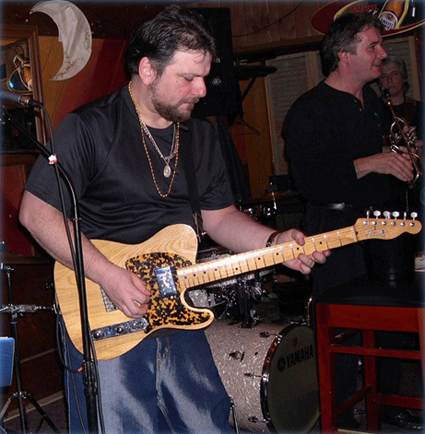
Joey Leone with his Fender Telecaster
Peace and Joy.
By the time Gibson got around to reissuing the Les Paul in 1968, they had long since run out of original New York Epiphone pickups, so the mini-humbuckers used on Les Paul Deluxes were post-’62 Epiphone pickups made by Gibson. That model was rushed into production when they found out that players wanted LP Standards with humbuckers rather than the goldtop with P-90’s that was the first reissue.
+1 on flats on a Tele, or a Jag, or a Strat for that matter.
I always keep flats on my Jag – nothing better for that snappy “Diamond Head” sound. A while back I bought a big box of old string sets from a music store – in it were many sets of Fender Goldene flats. They sound amazing on any of these guitars, especially with fuzz, as Joey mentions. You young pups should try this!
Hello Joey, This article on Leo Fauxpas is really GOOD. I’ve been playing thru Fender amps since 1965 (64 Princeton Reverb) & like em’. Remember what Leo called “Vibrato” is acually “Tremolo”….and he installed “Tremelo” bars on his Fender guitars (I guess they are “Vibrato” arms). Keep up the cool articles. Jon Greenwood.
I use flat wounds for slide, a standard strat set up & a strat setup with Airline VVs and a lipstick in the middle. They sound great, especially the standard strat. You can really thump the base, hammer the strings, and you get a mid range that wails. I was getting frustrated with string buzz and weak tone, so I tried ’em.
Looking back, most of what I do that I would say is somewhat distinctive came about by screwing something up and thinking, “Huh, pretty cool.”
BTW, I’ve been playing an original 59 Bassman from time to time lately. It’s too loud for what we do, but Lord! What a great amp!
I’ve used an acoustic baritone for slide. Killer sound. Big, bassy, growly… Charisma.
I use 11 gauge flatwounds on a Korean Les Paul copy, which I converted to P90 single coils. Acoustically they sound not to great, but amplified the tone, especially the bass area has improved dramatically. I use Pyramid Gold strings, which were around as early as the sixties.
What about Fenders biggest blunder the 71/4′ radius on the neck?
Joey,
I love your articles! Great insights on Clarence Leo and Gibson’s mistakes that turned out okay.
Recently I raised some outrage on a car forum when by referring to the ’57 Chevy as a flop. After the screaming died down, I explained it was the ONLY year model Chevrolet that was OUTSOLD by the corresponding Ford. For a good 15 years before and after the year of Sputnik, Chevy was king, but 1957 was a great victory for Ford. Of course, in the “Fall” of ’57, Ford brought out a better idea called Edsel.
One correction, Gibson did not acquire Epiphone in 1963. They made the purchase in 1957, for a mere $20,000. One stipulation in the contract was that as long as Gibson owned the Epiphone name, a picture of founder Epaminondas (“Epi”) Stathopoulo would be hung prominently at Gibson headquarters. To this day, Epi’s portrait hangs next to Orville Gibson’s.
I found this information in a multi-page history printed in the front of the 2008 Epiphone catalog.
Keep up the good work!
-Jim Smith
collection includes Squiers, Danelectros, a USA Fender 12-string acoustic, my dad’s 1923 Washburn parlor guitar and one of 128 Eastwood Phantoms