


The Shaggs. Now there was a band that was baad! No, I’m not talking street slang where you’re supposed to flip over the meaning. They were bad. There may never have been a recorded rock band that was worse. Couldn’t sing, couldn’t play, the songs were awful, and they were terribly produced. There’s a CD of their two albums. Check them out for yourself. BAD! In fact, the only GOOD thing that came out of the Shaggs was a legendary guitar and bass, the Avalon “Shaggs” models!
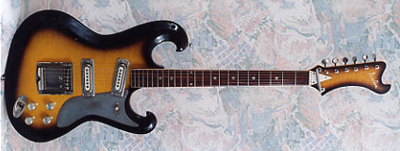
1960's Avalon Shaggs Electric Guitar
The Shaggs was a family band, basically the idea of Austin Wiggin, Jr., a poor mill hand whose mother once read his palm and told him he’d have daughters some day and they would be part of a band. The Shaggs were the fulfillment of that prediction, sort of American primitive. Hailing from the small town of Fremont, New Hampshire, the Shaggs was made up of Wiggin’s daughters, Betty (16) on bass, Dorothy (Dot, 19) on guitar, respectively, and Helen (20) on drums. Young sister Rachel sometimes also performed. Dot wrote the lyrics and developed the melodies, while Betty pitched in on working out chords and rhythms. Their primary musical influences were Herman’s Hermits, Ricky Nelson, and Dino, Desi and Billy. Austin was manager and named the band. He got the matching instruments from somewhere and the band took lessons until they recorded their first album in 1969. The guitar and bass were Avalons.
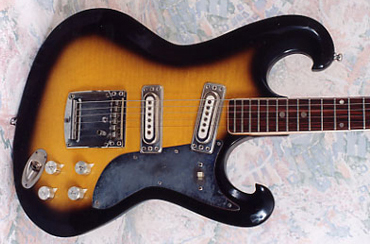
1960's Avalon Shaggs Electric Guitar
Now, these are known as Shaggs models because they’re what the Shaggs played, not because of some big corporate endorsement deal! No one knows who sold the Avalon brand. Mailorder? An area music store? An auto supply store? All possible. Nor who made them. Nothing like them shows up in the reference books. I’m not even sure when they were made, but 1967 or ’68 is a good guess. Japanese guitarmakers were competing with the Europeans early on in the 1960s and some of the earliest ‘copying’ was of European models. By the mid-’60s the EKO Violin guitar and bass, itself a copy of the Hofner made famous by Paul McCartney, was one of the most popular guitars to be honored with imitation. Another model that got imitated early on was the Burns Bison, with its long, pointy, inturned cutaway horns. The Avalon Shaggs were in the Bison mode. Come to think of it, buffaloes are kind of shaggy…
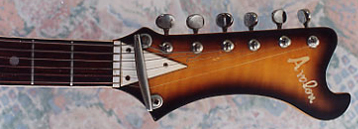
1960's Avalon Shaggs Electric Guitar
What can you say about the Avalon Shaggs that one look doesn’t explain. A cool shape, with maybe one of the greatest headstock designs ever, uh, conceived. We like to call the shape Goofy. Flamed maple top and back veneers (over plywood), done up in to-die-for black-to-yellow sunburst! Lots of chrome metal trim. I once claimed that the pickups on my Kent were the worst ever made. I lied. These little ceramic units are just as bad, if not worse! Making the fact that the Shaggs were even able to record with them at all is a miracle!
The Shaggs recorded a follow-up album in 1980, but that was the band’s last gasp. We don’t know what kind of guitars they used. Except for a (demented) cult following, these rare Avalons are all that’s left of their legacy. And they’re so bad, they’re positively baad. Know what I’m sayin’?
I believe the Wiggin sisters instruments and lessons were obtained through the Academy of Music in Manchester, NH. The Academy of Music was a storefront music school/music store in a bad section of downtown notorious for overpriced import instruments.
Not only did the Wiggin sisters perform at the Fremont (NH) town hall but also had a weekly gig at Carol’s Restaurant in Epping, NH. I regret that I never took the time to see them perform live as I only lived a couple of towns away.
Academy of Music! I took lessons there from the owner, Mr. Bruce. He was on Central Street at the former location of Thall’s Remedies. I got my first electric there, a Kent two pickup in red. He tried to convince me to buy a Harmony Jazz archtop, but I had no appetite for any hollowbody guitar back then.
Bought one of these as a kid – maybe 1968… at Eighth Street Music (on 8th street in Northern Liberties) in Philly. Passed over a then new Danelectro (U52?). Played the Avalon Shaggs a lot through a ’64 Tremolux blackpanel piggyback. Changed the frets, reset the neck, rebuilt and fixed the bridge, in about 1970 – installed new electronics and a pair of Gibson humbucking pickups, hand routed with chisel(s), made my own pickguard from surplus 1/8″ fiberglass sheet. Then it sounded like a Firebird, but played so-so. Replaced with a pawn shop special refin ’62 Strat – Oh boy, a world of difference. That’s long gone…
A buddy of mine in my first band got this as his first electric in about 1977. Probably came from Ted Herbert’s in downtown Manchester, NH. He sold it to buy something way better (a Ric 12, I think) and nobody knows where it is today. It may have very well belonged to the Shaggs!
I’ve been to Fremont town hall on business, and made sure to go have a look at the stage where the legendary Shaggs used to play.
You’re way too hard on the Shaggs. Frank Zappa, Kurt Cobain and Lester Bangs are among their “demented” following. I really like them a lot. They are THE antidote to the poser rock scene that has always been so popular. They are a deep breath of fresh air.
I don’t even understand how I stopped up right here, however I believed this publish was great. I don’t realize who you’re however definitely you’re going to a well-known blogger if you aren’t already. Cheers!
Hey there the loved one! I wish to declare that this information is brilliant, wonderful authored and may include virtually all crucial infos. I’d like to glimpse excess discussions such as this .
If anyone has a guitar like this for sale let me know, I’d love to buy one!
@John Austin, you left no contact info. But I have one of these I may part with for the right offer. Shoot me an email at gibsonexplorer72@gmail.com
From the pictures I’ve seen, the “flamed maple” is actually Anigre’, an african wood that is often used as a substitute for curly maple…Anigre’ is very soft, and when sliced into thin veneers (1/40th “), it is not very durable, but it is very pretty when finished into guitars, furniture, etc….
I actually feel sorry for the guy who wrote this. Yes, the Shaggs are “bad” but their recordings possess identity, charm, and enthusiasm. They may be trouble on ears accustomed to listening to “normal” music, but if you have the appropriate guts to actually approach listening to music in the context in which it was recorded, I’d argue you can come away with a richer understanding of what it means to be alive.
I’m not trying to suggest that their music doesn’t sound strange, and possibly demented. I’m suggesting that it’s possible to enjoy music that sounds that way. These were young girls encouraged to play in a rock band with their sisters and to make an album before they had any sense of how to play. That they came up with their own songs with rhythms and timbres that are quite unique, and that had lyrics about their own lives instead of just dull cliches about liking boys is to be applauded.
I think I can comfortably go out on a limb and say you’d be better off listening to the Shaggs than you would be by listening to something by Herman’s Hermits, Ricky Nelson, or Dino, Desi, & Billy. And I’m not even a (demented) cult member!
I was given one of these for helping a elderly lady move some stuff out of here basement a number of years ago. I’m really curious of the value but cant seem to find much info on it. anyone have an idea?
Andyy: Curious if you’ve been able to find anything out about the value. I have one too and came across this page…there doesn’t seem to be much else out there.
FujiGen Gakki made the Avalons in 1967 and I think 1968. They made guitars for other companies too. Decent Japanese guitars. At some point I think they were partnered with Fender.
Global Low-down About this offshoot
levitra: https://levitrahill.com/# vardenafil