


These days Epiphone guitars are almost ubiquitous. If a band plays Gibson-style guitars, they’re most likely to be slinging Epis. I’m not sure why, but I suspect it’s because the quality is pretty good, the sound is decent, the look is there, and, if some scumbag should manage to ease a case out of the back of your van when you’re looking the other way, you’re only out an Epi. In other words, the Gibson stays back at home. This is only the latest twist in a tale full of deliciously ironic symbiosis. Another turn is reflected by this extremely rare 1988 Epiphone Spotlight.
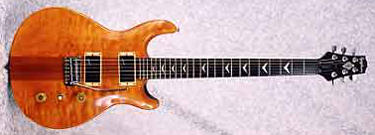
1988 Epiphone Spotlight Electric Guitar
Like on the telephone commercials with the wizard, the goofball crew and the “puppy,” I can hear you gasp, “What the…” Epiphone Spotlight? Never heard of that puppy. Nevertheless, this is a real beast.
I too had my doubts when I first laid eyes on this sweetheart hanging in a pawnshop down on South Street in Philly. Like almost everything I bought back in those days (mid-‘90s), nobody knew what the heck it was. The fit and finish (high gloss polyurethane) were too good, and besides it was a neck-through. That means some serious commitment. I snatched it right up for a couple bills, of course. The quilted top alone was worth that! This was a beaut!
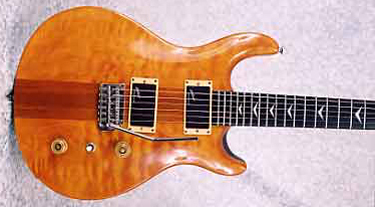
1988 Epiphone Spotlight Electric Guitar
But what was it? That’s when I started pawing through the Epiphone paper I’d managed to acquire. There it was, in a promotional pack from Gibson that my friend Michael Lee Allen had thrown in with one of my catalog orders. The Epi…no wait…the Gibson Nouveau series. Curiouser and curiouser!
Epiphone, of course, had been Gibson’s budget brand ever since they bought their fierce rival in 1957. Epiphone had become an imported line in 1971, thus beginning a long and complicated peregrination as an offshore product.
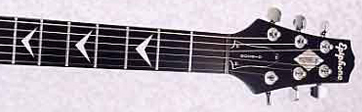
1988 Epiphone Spotlight Electric Guitar
But Gibson would periodically revive the American manufacture of Epiphone guitars, including some of the last guitars made in Kalamazoo before the final move to Nashville. Which is a fascinating tale, but doesn’t explain the Spotlight mystery.
Turns out that sometime after Norlin’s sale of Gibson to its current owners, someone hatched the plot to produce the Nouveau series. In the late ‘80s Japan was still regarded as a prime source of budget guitars (this was about to end). The Gibson Nouveaus were going to consist of parts made in Japan—neck and body—and assembled and finished in Nashville. This would, of course, technically keep them “American made.” This was not uncommon back then; Kramer seems to have specialized in the practice. The project got as far as introductory literature, as my paper stash demonstrates. As this guitar testifies, the rest of the plan was executed as well, but with another of those twists. Somewhere between the manufacture and finishing, these became the Epiphone Spotlight series. Maybe they got cold feet about the sleight of hand.
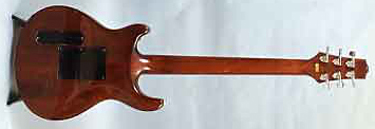
1988 Epiphone Spotlight Electric Guitar
In any case, the result was ironically a new—and no doubt rare—“American-made” Epiphone! And a fine one it is. The shape of this guitar is suspiciously like that of the brash young guitarmaker from Maryland named Paul Reed Smith, which were just beginning to make some waves at the time. The Spotlights have neck-through-body construction, with mahogany necks and bodies, capped with a gorgeous carved quilted maple top. As befitting the “budget-deluxe” concept, what looks like a two-octave ebony fingerboard is ebonol, like that used on early Kramers. Reflecting the Epiphone-by-Gibson branding used at the time, a pearl diamond engraved with “Gibson” graced the headstock. Pickups were EMG Selects, serviceable if not exceptional, hooked up one volume and one tone, the latter with a push-pull coil tap pot. This version was outfitted with a traditional style vibrato, but I have another one equipped with a locking Steinberger HB vibrato. There were most likely stoptails, as well, but who knows?
This is a really nice guitar. The heavy poly finish is a bit much, but there’s nothing not to like here.
As evidenced by how familiar we all are with the Epiphone Spotlights, they obviously didn’t last long. However many were made seem to be from 1988. A good guess is that probably one shipment of necks and bodies were produced. 50? 100? The two I have are among the three I’ve seen, all in Philadelphia. I don’t know if any of the Gibson Nouveaus were ever made, although the introductory literature shows photos of them, so at least a couple prototypes were probably put together before the switch to Epi. As common as Epiphones may be these days, the Epi Spotlights both uncommon and uncommonly good!
Just wanted to thank you for the info, I have a Spotlight that was purchased new for me by my father have owned it since 87/88 it still screams, I love hardly ever play it, but have been looking for info on it.
so thanks again
I have the Curly maple top version for sale. All original with the EMGs…
My email address is stephen64@comcast.net
Hey just wanted to say thanks for all the info. I too have a Red Metallic 88 Spotlight. Just to add a note here. I had the chance to see Mr. PRS himself at the Dallas Guitar Show back in the spring this year. Yes, just what you’re thinking, I did get him to autograph the famous lawsuit guitar. I will have to say he is a very down to earth person.
My email is monroe_69@sbcglobal.net
Hi Guys,
I was fascinated to read Michael Wright’s article. Too bad he is mistaken, but he came by it honestly. I’m sure that was Gibson’s plan for Gibson Nouveaux, but that is not what happened with the Epiphones. I have four Spotlights, one has all stickers– front and back, push-pull pot, etc.–and came in the wrapper, an NOS treasure find. Mine definitely says made in Korea. Same with the X1000s, same ebanol finger board, chevron inlays, work order stickers and Made in Korea stickers. Where Michael was absolutely WRIGHT (lol) is that they are great guitars. Put a pair of Lollar Imperials on the them and you’ll wonder how PRS manages to sell guitars at all! My email is cyapenser@gmail, love to hear from all y’all.
Interesting observation re. Korea. I checked with Jack Westheimer of Cort, which makes a ton of Epiphones,and he had no recollection of them. Unfortunately, in a worker dispute some time ago, employees destroyed a lot of old records. The information on the Gibsons comes from printed materials that came from Gibson and are like typed B&W sheets, probably meant for sales reps to show to dealers. I don’t recall if they also reference the Epis or if I simply drew a conclusion. When I get time I’ll try to find that packet of info to see. I have two of these and they ARE surprisingly good instruments. The fit and materials look better than Korean guitars of the time. The thick poly finish DOESN’T look Gibson. Let you know what I find out.
Gibson is so F’ing lost when it comes to records it hurts. Their Epi stuff is even worse starting in 1958 when they made the final sale to Gibson the NY Epi employees were burning parts out back in protest. I may have sent Gibson more schematics for amps than they sent me. PRS guitars are nice, but $6K nice? Hmmm!? All the law suit stuff does is make the customers suffer. Les Paul and Hummingbird copies used to be everywhere in the 70s. Some were plywood crap, and some really gave Gibson a run for their money and may be nicer. My Japanese expert only knows a little English, but he finds some way awesome no name copies. No name to us non Japanese that is.
Truth is Gibson ONLY wanted the rights to Epiphone’s contrabass production, but got the whole company instead. I have maybe seen 1 old pre war 4/4 Gibson contrabass in my life, and my uncle ran a music store with his widow running it another 20 years. I have seen maybe 2 Epi Contrabass (stand up bass) I find this very curious. If that 4/4 upright bass business was so damne hot why are most of the ones I see made by Kay, or are full blown Amatis, or other Cremona Italian highend orchestra models at $150,000 each? It seems Epi wanted out, and Gibson knew it. These Spotlights are incredible bargains still, as are some 1980s oddball Takamine that is similar. My 1040A kicked back so I missed the auction’s end in leiu of paying my taxes. $0.00 but they make you at least go through the motions. There were a few Epiphone oddities and some 60s Epi stuff that blows Gibson’s flagship dreadnaughts away. The Excelente, Pioneer, etc are all awesome guitars when they are pre 1970 models. The Excelente in particular was a real gem with Brazilian Palisander (rosewood) back and sides, and a spruce top. Gobson never made such a beast with that wood combo in that style. They do now, but who wants a new Gibson over a 1966 Epi?
Mike,
I have the 1988 pearl white Steinberger version of the Spotlight which I bought new in Flint, MI. There were actually a few thousand or more of the Spotlights made as proven by the serial numbers on my guitar. These guitars are unusual but not as rare as one may think. I left the stickers on all these years. My guitar is in mint shape. Yes the sticker says “Korea”. However, it must be taken into account that Gibson had attained Steinberger at this time and the purchase included many left over parts: hardware, body blanks, pickups, finger boards etc… These guitars are obviously made from these left over parts. Isn’t it strange that they put a sticker on them that say’s “Korea”? Gibson almost always stamps “USA” right into the wood on the back of the headstock. Also, look at the shape of headstock. It’s not quite like any Gibson I’ve ever seen. It doesn’t really look like a PRS headstock either. For the next model Spotlight, Epiphone used an Explorer type headstock. Just food for thought. I wouldn’t doubt that the mahogany body blanks and necks where Steinberger proto types. Gibson probably wanted to make some cash on these parts. It is most likely that the parts where shipped to a factory in Korea to be assembled. I don’t think that they planned on launching a new blockbusting model. What they came up with was a very good moderately priced guitar that looks very much like a PRS. The guitar actually plays better than the PRS’s of the time. However, the Steinberger bridge has it’s quirks and bugs (see other internet posts for fixes). Also, the pick ups although very clean, could be a bit hotter. I plan to keep my guitar in its original set up and try to preserve it in mint condition. The mystique around these guitars is definitely building and it is becoming a collector’s item. I really don’t know why they put the Epiphone name on it. It could have stood on it’s own as a Gibson model.
Wow, I have one of these that I bought in Britain in 1988 when I was 14 years old. It was my only electric guitar since then, until I bought an American Telecaster Standard yesterday. Feeling a little nostalgic about my old Epi, I Googled it and to my absolute surprise learned that it was a very short run and is a rare model. Mine is the exact same color as the one in your photograph. I think it could probably use a good setup – but it’s back in the UK and I’ve live in the US now. Maybe I’ll have it shipped across at some point. Everyone who ever saw it was totally blown away by its sound and playability.
Hi,
Just wanted to say that I have one of these as well, bought at a flea market probably around ’88 -’90 for $100, with the fretboard hacked up by someone trying to file the frets down. I had it cleaned up and refretted, and have loved it ever since, though I’ve never found a hard case to fit the thing, the headstock angles back a shade too much for most. Plays really nice, and it’s cool to finally know what it is! Mine is exactly like the one pictured here. Thanks!
PS – no one has mentioned this, but mine does NOT have a serial # stamped into the back of the headstock like most Gibsons. Are they all like that?
PPS – I should also mention that my other electric is also an Epiphone, a clearbody copy of the Dan Armstrong unit, and is also a really nice copy, removeable pickups and everything!
I have a Spotlight like the one you pictured, but it is candy apple red. It has the Steinberger bridge. Bought it a yard sale for not much money but never knew much about it until just recently. Beautiful guitar that plays great. It also has the chainsaw case. This is the first time I’ve heard it called that , but that describes it perfectly. Thanks for the added info.
Just wanted to add, the guitar has no stickers or a serial number.
I bought this guitar – in downtown center city Philadelphia (8th Street Music??) around 1988 – for about $300??. I have all the original parts (would it be worth more with all the original parts on back on it???) BEAUTIFUL, straight as an arrow neck through body (but wouldn’t stay in tune…so it has STAYED a closet classic!…probably sticking at the nut…little did I know that I probably could have simply fixed it with lubricant!!)
However, I put locking Sperzel tuners and a Wilkenson two point bridge – blocked off by a piece of wood to improve tone, sustain and mostly tuning stability, some kind of graphite nut (again for tuning…now I simply spray vegtable oil based lubricant all over the nut and bridge to keep in tune better…works very well NOW…). Also I upgraded the knobs to the circular pearloid chrome ones from Stewmac (dotcom?). (Very PRETTY!)
I am contemplating putting my best matched pair of humbuckers (Timbuckers) into it – perhaps with a five-way switch (if Timbuckers split??) and push-pull phase switching pot ala ’80s PRS customs (which is the guitar I REALLY wanted – WAY, WAY more money…into a Mark IV!). Who thinks this is a good idea??
I am also contemplating a Super-vee bridge and/or Tronical tuners (Awesome auto-tuners!! but I have NO IDEA which of there models/templates will FIT this guitar’s head stock…any ideas?? Trial and error: print out many templates and start lining them up??)
Thanks
James
I had one of these that my POS ex-wife had bought me just when we were dating as kids… I bought (she) bought it for my b-day… I absolutely LOVED this axe! People freaked when they played it. These with the Steinberger KB trem had issues that Gibson/Epiphone KEW about! The posts bed due to the lousy weld at the bottom of the post. I wrote them a few years after 1988(?) when I purchased it and they sent me a whole new redisigned (as far as posts) tremolo. Well, I got divorced and my love is missing!! So, I purchased another on Craigslist that had some dings and THREE screws broken off in the lower strap button (WTF?) and getting her back in shape, I found this guy in Germany who loves Steinbergers and makes replacement post!! Bought two, as I have my original tremolo from my missing Spotlight. these are fantastic axes!!
http://www.headless-europe.eu/Steinieland/Parts_Trems_02.html
I have one of these bought in Northern Ireland in 1989 for my 16th birthday and have never seen another in the flesh! Almost the same, the only difference being the steinberg floating trem. Not the most expensive but the best guitar I own.
Well, I will have to add to the list of folks that have one of these. My daughter acquired one of these from her late uncle. We have no idea when or where it was purchased but most likely in Toronto or Montreal (Canada). We do have a picture of the guitar on stage dated 1991. My bother-inlaw was a professional musician so it has been played. It has the most incredible sound and tone. Very light fingers. The only part missing is the “wa wa” bar. My brother-inlaw did not like them. So will need to get one to complete the guitar.
What I would like to know is where the serial number is locate? Can’t find it in either of the two access panels on the back. I would like this info so I can get a approximate value.
Hey guys , I just bought one of the spotlights and the original vintage style tremolo was replaced with something that looks like a stock fender, it was modified. Unfortunately the post spacing is wrong and the tremolo is no good I am trying to find a replacement tremolo but the post spacing is very different from anything that I have found. I’m wondering if these tremolos were used on any other guitars during that.. NOTE: I am not referring to the Steinberger type bridge. Mine is a vintage style as seen on the guitar above. if anybody can help please respond. Ftass@aol.com
Hello friends,
I too own a great Epiphone Spotlight CMT. I have created a Facebook Epiphone Spotlight Nouveau Owners page. If you interested please look it up and provide pictures of your guitars. I truly love mine and it still plays and sounds great..
Ed
Hi I note that the first post on this was some years ago with one last year and another early this year 2017, But thought I would add this info encase anyone is interested, I have all the original labels for my spotlight including the made in Korea, and the Gibson inspection signed label with its serial number that implies it was made in the USA ?.
Nope, never production manufactured in the U.S.
Majority, as in 99 percent, came down the same line with Washburns in Korea, and it has never been proven to be manufactured in Japan either, as Epiphone moved production to Korea about that time. I have 3, love these guitars, but all came from Korea, no matter the sexy rumor that a few were made here.
stopped production after a prs lawsuit
It is a nice article to read. I have recently repaired some parts for Epiphone guitar. My Epiphone guitar is the investment of my dad. So I take special care about this. Good to know about the Epiphone spotlight electric guitar. I want to buy a new one.
It is a nice article to read. I have recently repaired some parts for Epiphone guitar. My Epiphone guitar is the investment of my dad. So I take special care about this. Good to know about the Epiphone spotlight electric guitar. I want to buy a new one.
Here’s a Gibson Nouveau Spotlight for those who are interested
Gibson Nouveau Spotlight 1987 Amber Flamed Maple https://reverb.com/item/28954816-gibson-nouveau-spotlight-1987-amber-flamed-maple?utm_source=android-app&utm_medium=share
All the evidence tells us that these Epi Spotlights are built or have their origin in Korea, but so far no one has been able to nail down exactly where. One poster here checked and could find no connection with them being built at the Cort factory, but I may have the answer coming. I just bought a Samick guitar that has the unique shape and a number of the characteristics/features of the Spotlights, enough that by the pics I’ve seen of it I can say that they may have been built in the same factory. The serial number of this Samick starts with ‘S9’ and I know that to mean 1989 from information related to Squire Strats also produced at Samick. I will receive the guitar in a few days and will report back as soon as I inspect it. This Samick also has a Wilkinson tremelo on it, which may or may not be original to the guitar.
Another spotlight owner here. I have been trying to find out what model this guitar was for a long time as the serial number sticker fell off years ago. I bought it new and soon after replaced the pickups and tremelo. It would not stay in tune with that. Still play it now!
Thank you for the valuable info on the spotlight! Now I know what it is!
I have the exact same guitar shown in the pics. Headstock and placard is identical. Same EMG select pickups and everything. I bought it in 1990 from a pawn shop in Oklahoma. After about 10 years, I started noticing I haven’t seen another Gibson model quit like it. All across the US over the years, some musicians and band mates who were familiar with Gibson or other manufacturers had never encountered this model before, but were impressed by the quality and playability. Of course its been retired for the past 15 years, so it hasn’t been seen much. I’ve always wondered why it looked so much like a PRS, and just found out there was a lawsuit over the design between the two manufacturers. Thanks again!