


Return with us now to ancient Japan, when mighty Shogun warriors roamed the countryside like Medieval knights righting wrongs by wielding sacred iron battle axes… Oh, wait; this is about guitars, isn’t it? Still, when you gaze on this 1968 Kawai Concert, you’re looking at a remarkable example of early, idiosyncratic Japanese guitar design that, in a way, has more to do with being Japanese than with the demands of export marketing. Maybe this was because by 1968 the market was pretty soft, so it didn’t matter if they turned the designers loose. Or maybe it was an expression of pride. Or something in the water. Whatever the reason, in 1968 there was this whole batch of bizarre Japanese guitars that were unique and strange, many of them employing what seemed to be Asian aesthetics, most, though not all, from Kawai and its subsidiary Teisco.
Kawai was founded in 1927 by Koichi Kawai in Hamamatsu, Japan. Mr. Kawai’s vision was to create top-quality pianos, a quest in which he certainly succeeded! Kawai added guitars to its repertoire in around 1954 and eventually became a player in the ’60s Guitar Boom. Like many Japanese electric guitars, most early Kawai guitars were slightly frumpy, although my impression is that their electronics were a little better than some contemporaries. Probably the most prominent brand names in the U.S. manufactured by Kawai were TeleStar, whose sparkle models have a small but devoted following, and Domino.
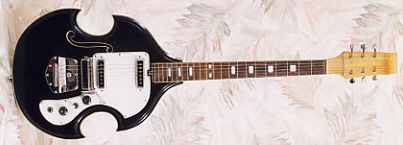
1967 Kawai Concert Electric Guitar
In January of 1967 Kawai purchased the Teisco guitar company, but they appear to have operated the two companies pretty much separately. Both lines featured exclusive designs and different pickups. Teisco continued the vector of evolution it had taken, ending up with the Spectrums and finally the mini-Strats, before becoming the Kay brand in the U.S.
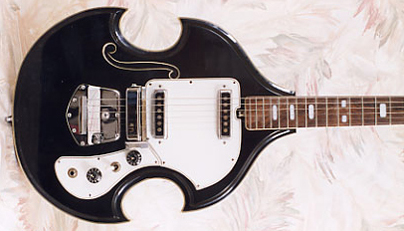
1967 Kawai Concert Electric Guitar
But in 1968, both Kawai and Teisco freaked out. Kawai produced models such as the axe-shaped Concert, plus a variety of unusual VS violin-bodied guitars (including one with 16 strings and its own pickup mounted parallel to the strings, whether sympathetic or strummed, who knows?), the Splender, shaped like a banjo, and another model shaped like a sitar. For Teisco, ’68 was the year that gave us the famous artist-palette-shaped May Queen, wildly flared, asymmetrical Fire Bird, and long-horn Phantom. One other company, Firstman (unrelated to Kawai), produced a model similar to the Concert called the Liverpool.
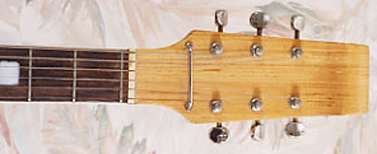
1967 Kawai Concert Electric Guitar
Like the Concert shown here, all of these oddballs were hollow, some like the Fire Bird in a traditional sense, others like the Concert consisting of two hollow halves glued together. The result is a cool, easy-to-carry guitar. The scrolled neck on this model was made of many multiple thin maple laminations, similar to the trademark designs of Framus. The big chunky pickups can have a pretty decent output, though it’s somewhat mitigated by the lightweight body. In addition to this black finish, there was also a sunburst, at least.
Look, these are really, really cool guitars. It’s not known whether these are particularly rare or not, but they were only made in 1968. Neither is it known if they were ever exported out of Japan. You sure don’t see many of them. Which is funny, because, let’s be honest, guitars like this are more about being seen than being played! Though the axe effect could come in handy if your fans decided to attack!…
My very first bass looked just like this!
I just got a Kawai bass from 1968 and it’s so far out!!!!
i have a kawai guitar looks like a stratocaaster my brother was in vietnam and sent me this guitar it is now 45 years old still plays beautifully and looks great i dont know what they called the guitar i have seen one other in rare guitar collection but it had 3 colors mine is black on the outside and maroon mine has kawai on the head this one had a different name same guitar they are unmisstakeable thanks ken HENDRIX
I have a Kawai (with headstock decal, so it is a Kawai) jazzmaster style guitar with 3 white single coils,
3 volume and 1 tone control knobs,3 sliding pickup switches on a chrome plate, tortoise pickguard,
laminate bound neck and vibrato in sunburst. The volume/tone knobs are mounted on a chrome plate as well. Zero fret. This guitar plays and sound very nice, the pickups are very rich sounding…Please, if some-
one has any idea of the approx. year it was made I’d truly appreciate it. Also, I’d consider selling it if anyone’s interested…Thank you!
My very first electric guitar was a Kawai double-cutaway, single-pickup, solid-body which I got for Christmas in 1966. Have not been able to find a photo or any info about it on-line.
I received a kawai violin shaped guitar green in color for christmas of 1968. It was purchased from a Eatons Store in Canada.It came with a amp.and a case.
I bought my Kawai circa 1982….She’s a Strat copy, made in Japan but with no visible serial number. Somewhere I have her detachable tremolo arm….but can’t guarantee finding it…
She holds fond memories for me, but I never really got to grips with solid body guitars, so she ain’t been played much! Therefore, she’s in pretty good condition. She’s rare in the fact that she is blonde. I’ve never seen one like her and I’m open to offers. Sadly, no case.
@ryan
I just acquired a guitar that may be the same model you’ve described, It’s a red burst color with a jag style body (more or less) . looks like the one in the link but with one pickup and no toggle switch.
http://www.ultimate-guitar.com/forum/attachment.php?attachmentid=75226
I have 3 Kawai Performer guitars.
– red burst
– brown burst
– natural
Love them all :-]
Just found this exact guitar in the corner of an antique store..Had pots cleaned..new strings..and it plays great..Everything original..I cannot find any info on one being sold for a comparison value..If anyone can help it would be greatly appreciated..Thanks..Gary
I just purchased a kawai prestige G -holiday electric guitar .It was told it was built in 1965.Does any body no what they used for wood
Gary,
I don’t know much about our Kawai guitars (I have a 70’s Performer), but from the little I could find out they were bloody good rock guitars, everything as good as Gibson, by the time the 70’s rolled around.
Because if their strength in Keyboards, they were easily pushed out of the market buy the then Aggressive Gibson attack!
I personally would LOVE to hear more…!
Hello
I am Alain and I have a kawai KS11XL.
Yesterday I bought to a secondhand goods dealer a new Kawai, copy of a SG Gibson, cherry and vibrato.
It is in good condition, just take off dust and new strings. I try the sound, it seems ok
Have you any information on this model, because I can’t find any on the net. What seems to be interesting is the name Kawai on the neck
Thank you
Regards
Alain from France
I have an 8 string guitar that says Kawaii on it but cannot find a picture of one or anyone who knows anything about it. Its shape is a double cutaway, starburst with pick guard. two small single coil p/u’s with a single cover over both. May be one p/u. haven’t removed the cover to actually look. not much bigger than a mandolin. any help identifying what it actually is would be greatly appreciated. thank you in advance for any help on this
I have a Kawai classical gt652 ,that I can’t find any information anywhere
Hello I am looking for the history, age and value of a 12 string accoustic Kawai & Co guitar reflecting F112 on the inside.
I think everything posted was very reasonable.
But, think on this, suppose you added a little information? I ain’t suggesting your
content isn’t solid, however suppose you added something that makes people want more?
I mean The Story of Kawai Guitars is a little boring.
You might peek at Yahoo’s front page and note how they create post headlines to get viewers to click.
You might add a video or a related pic or two to get readers interested about everything’ve got to say.
In my opinion, it could bring your website a little livelier.
I have a 1964 Sandtron prototype electric it is 1 of 10 built. As I understand it started life as a Kawai design and was finished as a Teasco I am looking for parts to finish restoring it.
I have the bass version of “Concert” style. I’ve had it since 1975… just found out today what it is. I’d love to purchase another one. Or at least find a neck or someone to make a neck for me.
I have a no 75 Accoustic guitar looks like A hummmingbird by gibson does any one know what year it was other than the late 60s
Glad I found this site. I have a single pick up Sorento and I am looking for information on it. If anyone can pass any information my Id greatly appreciate it.
Mark
There’s more info on the later Kawai guitar models at KawaiGuitars.com
I read that Kawai was the maker of Fernandes guitars and basses for some time. Does that ring a bell to anyone?