


When I first learned of this guitar, it was known among cognoscenti as the State of Ohio guitar. I once wrote and essay in which I dubbed it The Ugliest Guitar In The World. All of us had a point. The real name, however, is the Kay Solo King K4102, and it dates to that heady period just before guitars really took off in 1960. Clearly somebody was hung over at Kay that day! When I got a chance to actually have one, how could I pass it up?
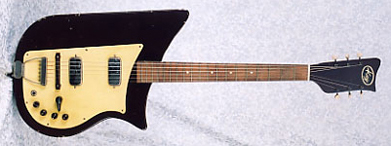
Vintage 1950's Kay Solo King K4102 Electric Guitar
Believe it or not, Kay was probably the first company to produce an electric guitar. The Kay Musical Instrument Company began in Chicago in 1890 as the Groehsl Company, changing its name to the Stromberg-Voisinet Company in 1921. (It changed to Kay-Kraft in the early ’30s, then just Kay.) While there are unsubstantiated reports that Gibson’s Lloyd Loar experimented with electricity in the early 1920s, it’s hard to imagine what he could have done. Electronic recording and amplification were not invented until 1924-25. Lyon & Healy reportedly had an electronic bass in 1923, but unfortunately it electrocuted players. Bummer. In October of 1928 S-V introduced the Stromberg Electro, a flattop with an electro-magnetic transducer that was played through an amp with no controls. A few Chicago radio players embraced the new technology, but the technology wasn’t there yet and only a couple hundred Electros were made. Modern-style electrics didn’t appear until 1931. Except for lap steels, and perhaps the early bakelite Rickenbacker Spanish guitars, Depression-era electrics were mainly archtops.
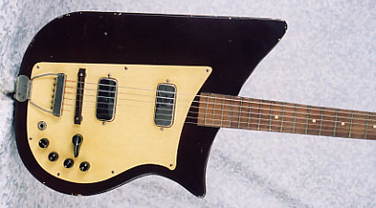
Vintage 1950's Kay Solo King K4102 Electric Guitar
After the War, Fender’s Telecaster didn’t seem to get much attention from mass manufacturers, but the Gibson Les Paul did, and by 1953 Kay, Harmony, and Valco were producing solidbodies. Kay’s, interestingly enough, were unibody construction, which basically means neck-through-body.
It was this concept that still shaped the Solo King, but what were they thinking?! It’s really hard to get your mind around this thing. It also appears to have unibody construction: one piece of wood. With the meat-cleaver head and BuckeyeState profile, it’s like no other guitar before or since. The effect is further enhanced by a – shall wee say – chocolate brown finish. The pickguard is made of a speckled formica. These single-coil pickups, while primitive, are actually not that bad, with a clean, crisp ’50s sound. A single-pickup version was also produced. The archtop-style bridge makes intonation a challenge and the fret job is a bit sloppy, but otherwise this doesn’t play that badly……. If, that is, you have the moxy to appear in public holding one! Can you see in the hands of Duane Eddy or the Ventures?
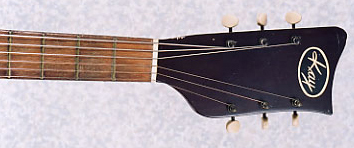
Vintage 1950's Kay Solo King K4102 Electric Guitar
Needless to say, the Kay Solo King didn’t catch on. The following year someone took a band-saw to the design and rounded off the lower bout to be more like a Les Paul. These were sold through Montgomery Ward. Another even weirder version had the upper shoulder and cutaway lopped off, and was sold as a Spiegel Old Kraftsman.
All these guitars were gone after 1961 and are particularly rare. I’ve seen guitars shaped like New Jersey, Texas, even the United States, but none really come up to the bad taste of the State of Ohio. Like I said, ugliest guitar in the world.
UGLY? Dreamy I’d say! Selling? PLease?!
Hi Michael, Thanks for the blast from the past. I was the person that owned the solo king that won the Vintage Guitar magazine Ugly Guitar Contest. Believe that was in the early 90s but not sure. Mine had a speckled beige tan brown bumpy paint finish (trunk paint as seen in old cars). Wish I still had it.
Has anyone seen or know of a Kay guitar called a Patriot. It’s a typical big body F hole arch top but is all blond with painted on tiger strips and (here’s the cool part) has red whit and blue pin striping on the body, red white and blue block fret makers and even red white and blue tuning peg tips. It came in a 1930-40s case so I’m assuming it’s that era. I have never seen another one. No markings or numbers, just says Patriot. No Kay emblem but sure looks like it was made by Kay.
I bought a used, still in excellant condition, Crucianelli electric guitar (before it’s merging with Eko, in mid 50’s from an old man in california. Wonder if it has nay value. It has 2 knobs and 3 sound controls. There is #1740 etched on chrome plate in b ack. Also has ivory in both front and back.
bob goucher
You know I actually really like this Solo king. Seems like a lotta players just want something different. Johnny Ramone with his Mosrite. J Mascis said the only other person he knew of playing a Jazzmaster was Elvis Costello. The list goes on. Maybe Nickelback will catch on and Chad will want to set himself apart from all the other lame bands so he’ll pick up a SOlo King and rock it for all it’s got and then you’ll see these younger bands all like, “Whoa! Dude, what’s that rad guitar the Chadmaster’s playing in their new video?” and the friend will be like, “Which video, maaaaaan?” and the other guy will say “That one for the song called ‘Chodester’ or ‘Chode Master’ or something,” and the friend will YouTube the video and sart yelling “That’s a Solo King! A SOLO KING!!! Let’s get matching Solo Kings!!!” so they look on eBay and Amazon but there aren’t any so they look harder and come across the Solo King replicas from MyRareGuitars and they buy them and start singing bad Nickelback lyrics like “I been hanging out with chodes, I been picking my Canadian nose, and I ain’t never gonna STOP!!!” or something and they’ll strum their Solo Kings and they’ll totally rock.
great thanks broooo