


I’m not really an amplifier aficionado. I know that’s not politically correct. I tend to like solid state amps because they’re clean and let the sound of the guitar through. In fact, my favorite amp is a Polytone Mini Brute. It’s like 14″ cubed, easy to carry, and loud as hell. If I want to sound nasty, I punch in an old Rat, etc. But one thing I am a sucker for is the True Vibrato found on 1950s Magnatone amps. True Vibrato, of course, is pitch, not volume, modulation. Most amps have tremolo (volume mod). I’m not alone in liking Magnatone vibrato. That’s the shimmering sound you hear on those late ’50s Buddy Holly classics Words of Love and Peggy Sue.
To own an original Bigsby electric you’d probably need a quarter mil of the ready. But maybe not! You might be lucky enough to find one of Bigsby’s Magnatone creations for a heckuva lot less.
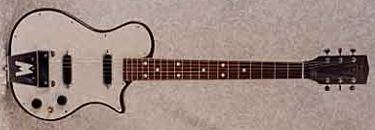
1956 Bigsby Magnatone Mark III Electric Guitar
Magnatone’s True Vibrato appeared in 1956, the same year a lesser known event occurred in that storied company’s history. That was when they contracted with one of the legends of guitar history, Paul Bigsby, to design a line of electric Spanish guitars for them. Magnatone had been a major player in the Hawaiian lap steel game ever since its founding by the Dickerson Brothers back in the late 1930s in L.A. We all know Bigsby as the inventor of the hand vibrato that still bears his name. But he also gets credit for making the first ‘solidbody’ electric guitar for Merle Travis in 1947 (it was actually semi-hollow). The same guitar that another amp guy named Leo Fender took quite an interest in shortly before coming up with his Broadcaster.
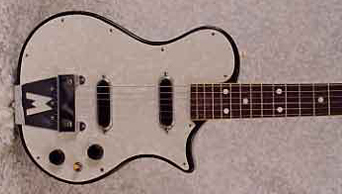
1956 Bigsby Magnatone Mark III Electric Guitar
Bigsby’s first “commercial” design for Magnatone was the Mark III, a neck-through-body semi-hollow guitar, Bigsby’s take on a Ricky Combo. We know some of these were built because one turned up a few years back at an L.A.-area yard sale (how often have you had that fantasy!). But it appears that Magnatone’s production folks made some changes and almost all that are found with solid bodies and a glued-in neck with a “tongue” extension that slips in under the neck pickup. The formica pickguard and Daka-Ware knobs are a little dated now, but back in ’56 they were strictly the cat’s pajamas!
The Magnatone Mark IIIs are pretty cool, but aren’t truly professional guitars, like the spectacular Mark V that followed in 1957. These actually garnered a bunch of professional endorsements. Nevertheless, all these Bigsby Magnatones were among the better guitars of the 1950s.
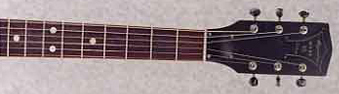
1956 Bigsby Magnatone Mark III Electric Guitar
How many early Magnatones were actually produced is a mystery, and they didn’t seem to do that well. They were gone by 1958 and replaced in ’59 by a new line designed by former National exec Paul Barth, though no Magnatone guitars ever conquered the guitar world, even when guitar ace Jimmy Bryant endorsed them in the mid-1960s.
So, next time you?re prowling a back rack or a yard sale, keep your eyes peeled for one of these Magnatones. It’s a genuine Bigsby and, when you push the large single-coils through True Vibrato, you get a classic ’50s sound that takes you to paradise! True words of love!
Hello Mr. Wright,
I left you a question in the “Contact” section of this website, thinking it may be a bit lengthy for a comment spot, regarding a Paul Barth sunburst purchased in ’55 with the exact design that may have become the Magnatone MarkV1 (post Paul Bigsby design) that you spoke of in the story posted above entitled “Buddy Meets Bigsby” I hope that you’ve received it and can shed some light on the matter. I sure would like to know which guitar I have. Thanks, Manny
I have this exact guitar as pictured above, mine is worn on the back of the neck from being played for all these years, in the original case, any idea of value? Again it looks just like the one pictured here, has the neck through body, can assume semi hollow, because I am not taking it apart.
I FOUND ONE!!! Yesterday at work!! I do, well I guess rape the dead? I clean out homes after someone dies for the Banks. I get anything I don’t trash. I found a MARK III… Its in rough shape.. But It sounds like I need to restore this Baby.
Mine Is earlier then the one Pictured. Single Pickup. Very Cool. Neck Through Body.. but that is where some damage is.. looks like the glue failed.. NOT BROKEN just released.. re-glue should fix that. Some damage to the Nut Area.. NOT BROKEN
just missing Nut and some glue/putty needs to be removed. The Finish on back of Body needs repair.. Maybe.
Are these that rare? Is she a Keeper? EBAYER??
I do have to say that it is Small and VERY COOL..But do I NEED another Guitar?
When I was about 18 or so I found a Magantone Mark IV in a local music shop for $125. It was a good little guitar, obviously well made except for what looked like a thin sheet of cherry-colored plywood or paneling on the back and those damn lousy Kluson tuners! Eventually I traded it in for a Ventura copy of a Gibson SG doubleneck. Looking back on it now I’m sorry I let it go since the doubleneck turned out to be way more guitar than I really needed at that time, but I hope it found its way into the hands of a good player who appreciated it better than I did back then!
I have this guitar the only difference is the pickups are chrome. I bought it new as a teenager in 1956. the Back of the neck has a bit of wear other then that it is in
great shape. Any idea what it is now worth. I don’t remember what I paid but had to make weekly payment for a long time.
Thanks bob
I have had this guitar since 1960 and trying to find out what it might be worth ,as i have a potential buyer?
To say the Mark iii’s are not truly professional guitars just means your Mark iii must have something wrong with it. The pickup should be able to go from audible whisper to total bark. I own four Mark iii’s and a Mark V. My neck-thru Mark iii and one of my glued in Mark iii’s blow everything else I have out of the water. They have PERFECT intonation, you can’t knock them out of tune, and they play like butter. I choose those guitars 80% of the time over a ‘61 Jazzmaster, a ‘66 ES-335, and on, and on. I’d just take issue that this is somehow not a professional guitar. I think the Mark iii is one of the top 5 guitars ever produced. There, I said it. Get your pickups checked, and maybe a setup, I dunno?
hi,
I am looking for a magnatone mk3. I will pay good money. If anyone has one please leave your email address and I will get in touch. Cheers
I have a mark III, single pick up, black (the only one I’ve ever seen in that color with a single pick up) with original case. I believe it is a 57 which would have been produced for about 13 months. It is not the neck through model, but this thing screams. Replaced bone nut and professionally set up. It is missing the headstock logo. Could use a re-fret if you were looking to play it regularly. It is for sale, so make me an offer. The worst I can say is no.
I have a mark III for sale..