I count myself among the many of you who have discovered just how good guitars made by the Matsumoku factory in Matsumoto City, Japan, really are. Or were. They still exist as artifacts but have not been made more than two decades now.
Archive | 1980′s Vintage Guitars RSS feed for this section
Matsumoku’s Atak Gains The Ad-Vantage (Vintage 1984 Quest Atak-6 MK II Electric Guitar)
Hair Bands, Soviet Russia & the 1989 Kramer Gorky Park Electric Guitar
January 1, 2011
Behind every guitar there’s some sort of story, but they usually aren’t as rich as the one behind the Kramer Gorky Park seen here! Not only was this guitar associated with one of the big flash-in-the-pan pop metal bands of the late 1980s, it symbolically and almost literally marked the end of Kramer, as the largest guitar company in the world was crumbling just like the Iron Curtain!
Catching a Wave (1984 Takamine Electric Guitar)
October 1, 2009
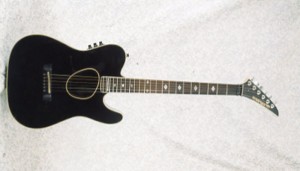
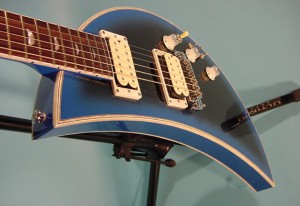
I don’t go to guitar shows much any more. I should, because I have a lot of friends who ply the floor, but I’ve been on a guitar diet for several years now. And my friends always find something goofy for me to buy. That’s how I ended up with this mysterious and rare Takamine solidbody guitar from 1984. What the heck is this?! I didn’t know and the dealer who knew enough to bring it to me didn’t know either, but he knew I would have to have it!
Center Stage in the Spotlight (1988 Epiphone Spotlight Electric Guitar)
May 1, 2009
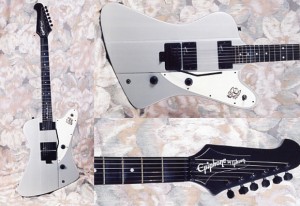
These days Epiphone guitars are almost ubiquitous. If a band plays Gibson-style guitars, they’re most likely to be slinging Epis. I’m not sure why, but I suspect it’s because the quality is pretty good, the sound is decent, the look is there, and, if some scumbag should manage to ease a case out of the back of your van when you’re looking the other way, you’re only out an Epi. In other words, the Gibson stays back at home. This is only the latest twist in a tale full of deliciously ironic symbiosis. Another turn is reflected by this extremely rare 1988 Epiphone Spotlight.
Sandwich Time (1982 Daion Savage Power Mark XX Electric Guitar)
September 1, 2008
In many ways, the spectacular Japanese-made 1982 Daion Savage Power Mark XX shown here was the offspring of something intended to end, or at least seriously damage, Japanese guitar-making itself… In other words, this guitar shouldn’t exist.
Workin’ for the Weekend. No really! (The Story of Hondo Guitars)
July 1, 2008
Hondo was founded by Freed and Tommy Moore in 1969 with the intention to open up guitar production in Korea, at that time a non-player in the guitar game. Japan had taken over from Europe as the primary supplier of budget-level guitars during the 1960s. However, even by the late ‘60s the success of the Japanese was being eroded by their very success and the strength of the yen. Americans, mostly as an after-effect of World War II, had little respect for Japanese products and weren’t willing to pay much for them, even if they were pretty good. When Nixon cut the dollar loose to float with other currencies on the free market, the yen went up, making Japanese products increasingly expensive, a problem in a prejudiced, price-sensitive market like the US.
Off With Her Head! (1986 Ibanez Axstar AX75 Electric Guitar)
May 1, 2008
Maybe it was punk rock, with its rejection of good guitar playing. You know, any old bloke can bash on a guitar and who cares if it’s in tune. More likely it was punk’s more popified successor New Wave which opted for tasty yet understated guitar textures (in tune), though still without the slashing guitar solos, matching costumes accepted. Think Andy Summers and the Police. Whatever the cause, right at the beginning of the 1980s a new type of guitar appeared on the scene. An understated, minimalist guitar with no head, like this 1986 Ibanez take on the form, the Axstar AX75!
How About a Twisted Sister? (1985 Schecter Genesis G6 Illusion Electric Guitar)
April 1, 2008
When Darcy Kuronen, the musical instrument curator at the Museum of Fine Arts in Boston, contacted me in early 1999 about their upcoming exhibition of guitars as art, which eventually became the Dangerous Curves exhibition, I was psyched. Guitars as art is my credo, why I collect. Well, at least one of the reasons. After a lot of sifting and winnowing, we agreed on a list that included a bunch of my guitars and a hyper-suspensioned, climate-controlled art moving van showed up to spirit my pretties up to Beantown. My Aria Pro II Urchin Deluxe became the visual emblem of the show, on the catalog cover, billboards, bus signs, banners. Pretty cool! Tucked away at the bottom of the pile was this 1985 Schecter Genesis G6 Illusion guitar!
Skeletons in the Closet (1980′s Astron Gittler II Electric Guitar)
February 1, 2008
Whatever you call this instrument, the Gittler certainly pushes the envelope of what is a guitar! Alan Gittler (born in 1928) was originally a jazz guitarist in New York, heavily influenced by Remo Palmieri. He played music, composed, and even wrote and produced a film called Parachute to Paradise. He worked as a film editor for many years, invented a number of photographic-related devices, and even wrote a novel.
Electric Ladyland (1983 Electra Lady XV1RD Electric Guitar)
June 1, 2007
I love the classic guitar shapes. They’re what attracted me to the guitar oh those many years ago. But as you can probably tell from these little essays, I’m also a sucker for a pretty face. Pretty weird, that is. Like this 1983 Electra Lady XV1RD with a Little Dutch Girl shape!


February 1, 2012
4 Comments